
RBI Zero Liability Rule 2027: Refund for Unauthorised Bank Transactions
- 18 November 2026 | 42 Views | By Mint2Save
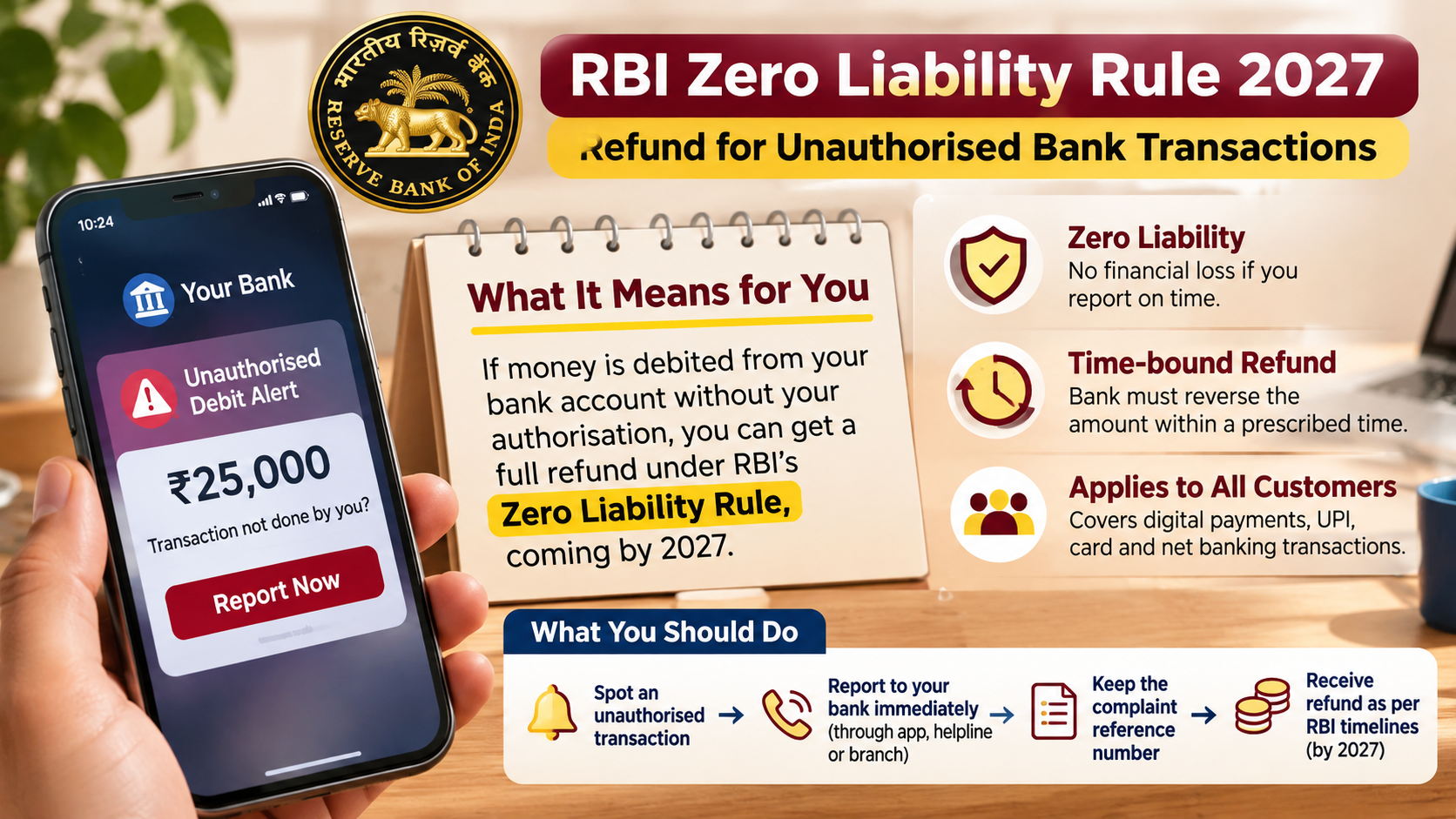
Money leaves your account through UPI, a card, net banking, or a wallet, and you never approved it. Do you get it back? In many cases the answer is yes, and the bank has to prove otherwise. That protection comes from the Reserve Bank of India’s “zero-liability” framework. It was first set out in July 2017, and RBI has rewritten it for transactions from 1 January 2027. This article explains both versions: the rules that apply today and the rules that start in about six weeks.
RBI zero liability rule: the short answer
- If the bank is at fault, you pay nothing. This holds even if you never reported the transaction.
- If the fault lies outside both you and the bank (a merchant, payment app, gateway, or telecom breach), you pay nothing provided you report quickly. Today that means within 3 working days. From 1 January 2027 it means within 5 calendar days.
- If you shared your PIN, OTP or password, you bear the loss until you tell the bank. Everything lost after you report is the bank’s problem.
- In every case, the bank carries the burden of proof. It must show that you were negligent. You do not have to show that you weren’t.
Where the rule comes from
RBI issued circular RBI/2017-18/15 (DBR.No.Leg.BC.78/09.07.005/2017-18), Customer Protection – Limiting Liability of Customers in Unauthorised Electronic Banking Transactions, on 6 July 2017. RBI later folded these instructions into its 2025 Responsible Business Conduct Directions for each category of bank.
On 24 June 2026, RBI issued the Reserve Bank of India (Commercial Banks – Responsible Business Conduct) Third Amendment Directions, 2026 (RBI/2026-27/167). Matching amendments were issued for small finance banks, payments banks, regional rural banks and co-operative banks. The new rules apply to electronic banking transactions carried out on or after 1 January 2027. Until then, the 2017 rules govern.
Every bank must also publish its own board-approved customer protection policy built on these rules. Banks such as SBI, Canara Bank, Bank of Baroda and Federal Bank publish theirs on their websites.
The rules today (transactions up to 31 December 2026)
When you have zero liability
- Bank’s own fraud, negligence or deficiency. You pay nothing, whether or not you report it.
- Third-party breach. The fault lies neither with you nor the bank but somewhere else in the system. You pay nothing if you notify the bank within 3 working days of receiving the bank’s alert about the transaction.
When your liability is capped
If you report a third-party breach 4 to 7 working days after receiving the bank’s alert, your liability per transaction is the transaction value or the cap below, whichever is lower.
| Type of account or instrument | Maximum liability |
|---|---|
| Basic Savings Bank Deposit (BSBD) account | ₹5,000 |
| All other savings accounts; prepaid instruments and gift cards; MSME current/cash credit/overdraft accounts; individuals’ current/CC/OD accounts with average balance or limit up to ₹25 lakh; credit cards with limit up to ₹5 lakh | ₹10,000 |
| All other current/CC/OD accounts; credit cards with limit above ₹5 lakh | ₹25,000 |
If you report after 7 working days, liability is decided under your bank’s board-approved policy.
Working days are counted by your home branch’s working schedule. The day you received the bank’s alert is not counted.
When you bear the loss
If the loss happened because you were negligent, such as by sharing payment credentials, you bear the full loss until you report it. The bank bears any loss after that. A bank may still waive your liability at its discretion.
How fast you must get your money
- Within 10 working days of your report, the bank must credit the disputed amount to your account. This is a “shadow reversal”. The bank cannot wait for an insurance claim to settle, and the credit is value-dated to the date of the fraud.
- Within 90 days of your complaint, the bank must resolve it and decide liability. If it fails to do so, it must pay you as though you were entitled to compensation under the zero or limited liability rules.
- You lose no interest on a debit card or bank account. On a credit card you bear no extra interest.
What changes from 1 January 2027
The 2026 amendments keep the core idea but widen and tighten it.
Wider coverage: “fraudulent” transactions, not just “unauthorised” ones
The new rules cover fraudulent electronic banking transactions. This includes transactions a third party runs using credentials obtained by fraud. It also includes transactions you approved under coercion or duress from a third party, as well as unauthorised transactions. The old rules spoke only of “unauthorised” transactions.
The Directions now define who is negligent:
- Bank negligence includes failing to keep mandated security systems, failing to send mandatory alerts, failing to provide 24×7 reporting channels, failing to act diligently on your report, and system malfunctions, security breaches or internal fraud.
- Customer negligence includes failing to protect your PIN, password or OTP, delaying notice to the bank, ignoring specific scam warnings from the bank, downloading malicious apps, and not updating your registered contact details.
- Third-party breach covers deficiencies outside both bank and customer, explicitly including third-party UPI apps, payment aggregators, payment gateways, and telecom providers.
The new liability rules
| Situation | From 1 January 2027 |
|---|---|
| Bank negligence | Zero liability and full reversal, reported or not |
| Third-party breach, reported within 5 calendar days of the transaction | Zero liability and reversal |
| Third-party breach, reported later | As per the bank’s policy |
| Customer negligence | You bear the loss until you report it, less any small-value compensation (below) |
| Any loss after you report | Borne by the bank |
Two practical differences stand out. The window is now counted in calendar days from the date of the transaction, not working days from the bank’s alert. And the fixed ₹5,000/₹10,000/₹25,000 caps are gone.
New: one-time compensation for small frauds
For the first time, even a victim who was tricked into the fraud may get part of the money back:
- Who: a bona fide individual victim, including a sole proprietor, with a gross loss of up to ₹50,000.
- How much: 85% of the net loss or ₹25,000, whichever is lower.
- How often: once in a lifetime. For a joint account, only one holder may claim.
- Condition: you must report the fraud on the National Cyber Crime Reporting Portal (cybercrime.gov.in) or helpline 1930, and to your bank within 5 calendar days.
- Payment: the bank pays within 5 calendar days of receiving your application.
- Who funds it: mostly RBI, with shares from your bank and the beneficiary’s bank.
- Duration: the scheme covers frauds occurring up to one year from 1 January 2027.
Faster resolution
- The bank must resolve your complaint within the timeline in its policy, capped at 45 calendar days for domestic fraud and 60 calendar days for cross-border fraud. The old cap was 90 days.
- For credit card fraud, the bank must give a shadow reversal within 5 calendar days of your report.
- Reversals are value-dated to the original transaction date, with no loss of interest and no extra charges.
- If the bank rejects your claim, it must give you its reasons and supporting details.
Better alerts and reporting channels
- Instant SMS alerts are mandatory for transactions above ₹500. Email alerts are required where an email address is registered.
- Every alert must show the account or card number, amount, date, time, channel and beneficiary or point of transaction. Each SMS must include a number you can use to object immediately.
- Banks must offer 24×7 reporting through channels such as phone banking, SMS, a dedicated email, IVR, a toll-free helpline and the home branch. A direct reporting link must appear on the bank’s website homepage and in its app.
- You must get an immediate acknowledgement with a complaint number and the date and time it was received.
What to do the moment you spot a fraud
Speed decides most of these cases. SBI’s published guidance for its customers sets out the sequence. It applies to any bank:
- Block the card or account at once through your bank’s toll-free number, app, net banking or branch.
- Report to the cyber police on helpline 1930 or at cybercrime.gov.in. From 2027, this report is a condition for small-value compensation.
- File a formal complaint with the bank through its online grievance portal or a branch. Keep the complaint number and acknowledgement.
- Keep your registered mobile number and email current. Under the 2027 rules, failing to update them counts as customer negligence.
If the bank doesn’t pay up: the RBI Ombudsman
The Reserve Bank – Integrated Ombudsman Scheme, 2026 replaced the 2021 scheme from 1 July 2026. Its main features:
- Complain to your bank in writing first. If the bank rejects the complaint, you are not satisfied with the reply, or it does not respond within 30 days, you can go to the Ombudsman. For unauthorised electronic transactions and fraud cases, this waiting period is aligned with the longer resolution timelines prescribed for them.
- Filing is free, and there is no cap on the value of the dispute.
- The Ombudsman can award up to ₹30 lakh for consequential loss and up to ₹3 lakh for mental agony, harassment and expenses.
- How to file: online at cms.rbi.org.in, by email to crpc@rbi.org.in, or by post to the Centralised Receipt and Processing Centre, 4th Floor, Reserve Bank of India, Sector-17, Central Vista, Chandigarh-160017. RBI’s contact centre number is 14448.
Key takeaways
- The bank must prove your negligence. You don’t have to prove your innocence.
- Bank-side failures mean a full refund whenever you report.
- For everything else, the clock matters: 3 working days today, 5 calendar days from 2027.
- From 2027, even victims of tricks and coercion can claim up to ₹25,000 once, if they report to 1930 or cybercrime.gov.in and the bank within 5 days.
- Read your own bank’s customer protection policy. Banks may be more generous than RBI’s minimum, never less.
Related Posts

Subscribe to get the best of finance and fintech. Regularly.
Categories
Popular

- 31 May 2016 | 18629 Views

- 16 June 2020 | 16029 Views

- 19 May 2021 | 15537 Views

- 14 May 2021 | 12302 Views
Recent


- 12 November 2026

- 11 November 2026