
How Health Insurance Premiums Are Decided in India: Renewals, Top-ups, Clauses & Government Schemes (2026)
- 15 November 2026 | 47 Views | By Mint2Save
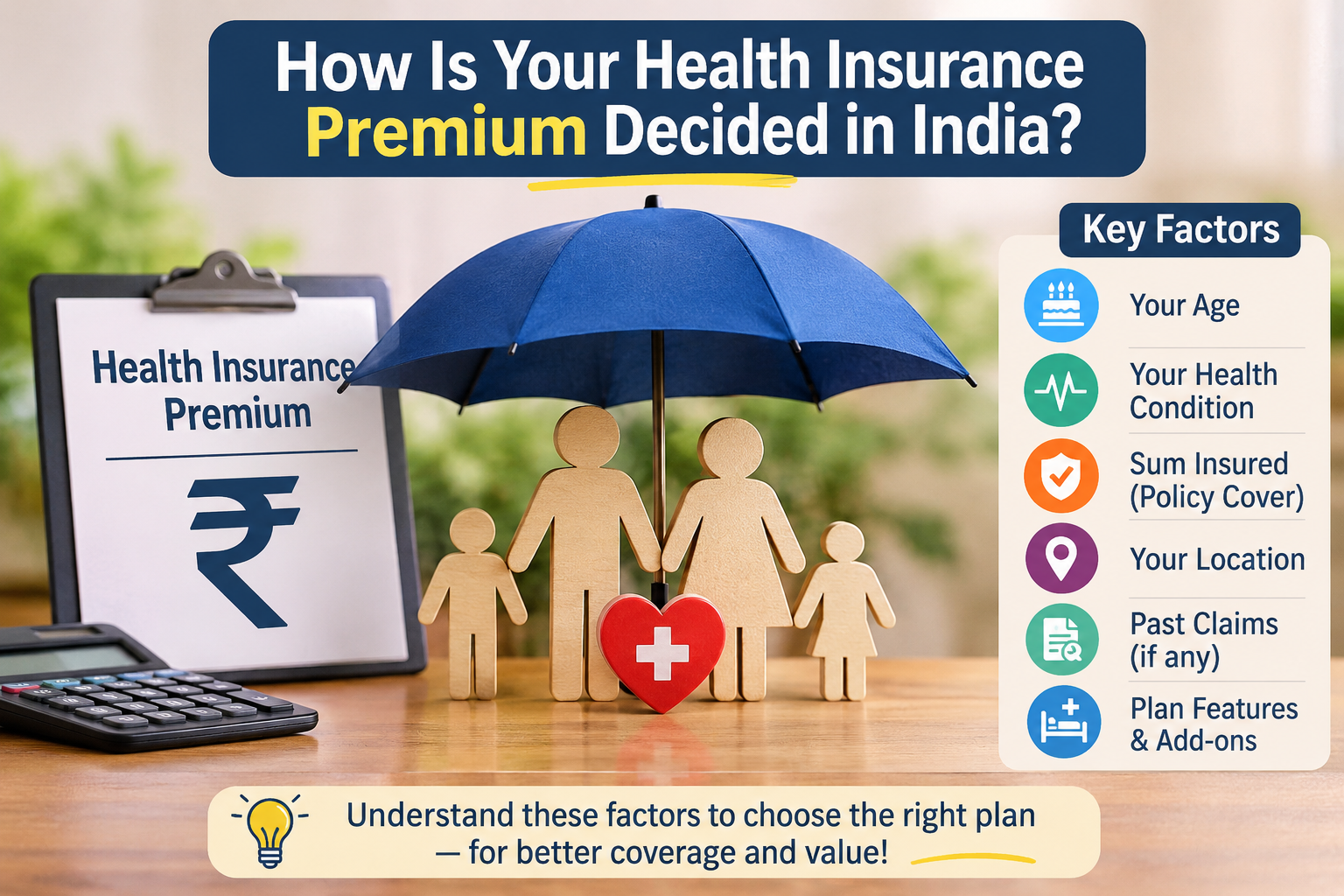
Have you wondered how is your health insurance premium decided in India? And what happens at renewal, how top-ups work, the clauses that matter, and the government schemes you may already have.
Two friends buy the same ₹10 lakh health policy from the same insurer, and one pays 40% more than the other. Nobody made a mistake. A premium is not a fixed price tag. It is a calculation. Once you understand how it works, you can make better choices about what you buy, what you renew, and what you sign.
This guide is based mainly on official sources: IRDAI (the insurance regulator), the National Health Authority, the Ministry of Health, the Department of Financial Services, ESIC, and CGHS. You must go through these Vital Health Insurance Tips
This guide has been to simplify the concerns around health insurance and how an average earner can create a better plan for himself and his loved ones.
Part 1: How the premium is calculated
The basic idea
An insurer collects premiums from many people and uses that money to pay the hospital bills of the few who fall ill. Your premium is your share of that pool:
Premium = Expected claims cost + Expenses and commission + Profit margin, adjusted up or down for your risk
Expected claims cost = how often people like you are hospitalised × how much each hospitalisation costs.
IRDAI’s product-filing formats ask insurers to justify their prices with these same measures: claim frequency, average cost per claim, burning cost (frequency × average cost), loss ratio and combined ratio. In other words, your premium starts from statistics on people like you, not from a guess.
The factors that move your premium
1. Age. This is the biggest factor. Premiums are set in age bands (for example 18–25, 26–35, 36–45, 46–50 and so on) and rise when you move into the next band. In a family floater, the eldest member’s age largely sets the price.
2. City (zone). Insurers group cities into zones by treatment cost. Metros cost the most and smaller towns the least. If you buy a lower-zone policy and then get treated in a metro, the policy may apply a co-payment.
3. Sum insured. More cover costs more, but less than proportionally. ₹10 lakh does not cost twice as much as ₹5 lakh, because most claims are small.
4. Your health (underwriting). At the time of buying, the insurer looks at your medical history and test results. It can accept you at standard rates, add a loading (an extra percentage on the premium), apply waiting periods, or decline the proposal. Smoking and BMI also matter.
5. Policy design. Features such as no room-rent cap, consumables cover, a restore benefit or maternity cover increase the price. Cost-sharing features such as co-payment, deductibles, room-rent caps and disease-wise sub-limits reduce it, because you pay more when you claim.
6. Individual vs floater. In an individual policy, each person has their own cover. In a floater, the family shares one sum insured, which is cheaper but can run out if one member has a big claim.
7. Discounts. Common discounts are for multi-year terms, buying online or direct, covering several family members, and wellness programmes. The cumulative bonus (also called no-claim bonus) usually increases your cover for each claim-free year rather than reducing your premium.
8. Medical inflation. Hospital costs in India are estimated to rise by roughly 11–14% a year. This is the main reason renewal prices go up even when nothing about you has changed.
9. Tax. Since 22 September 2025, individual and family floater health premiums are exempt from GST (it was 18% earlier). Group and employer policies still carry 18% GST. You can still claim the income-tax deduction (₹25,000 for self and family, ₹50,000 if a senior citizen, plus the same again for parents) only under the old tax regime. This deduction was Section 80D. From tax year 2026-27, the Income-tax Act, 2025 renumbers it as Section 126 with the same limits.
Worked example (illustrative numbers)
Profile: Age 30, lives in Mumbai, ₹10 lakh individual policy, controlled blood pressure.
| Step | Adjustment | Premium |
|---|---|---|
| Base rate (age band 26–35, Zone 2) | — | ₹10,000 |
| Zone 1 (Mumbai) | +15% | ₹11,500 |
| Medical loading (hypertension) | +10% | ₹12,650 |
| Add-on: consumables + no room-rent cap | +6% | ₹13,409 |
| Chooses 20% voluntary co-pay | −15% | ₹11,398 |
| 2-year policy discount | −5% | ₹10,828 |
| GST | 0% (was 18% → ₹12,777) | ₹10,828 |
These are made-up numbers to show how the adjustments stack up. Real rates differ by insurer and product.
Part 2: Renewal premium — what can and can’t change
Renewal is when most people feel the price increase. IRDAI rules set clear limits on what an insurer can do at renewal.
What the rules protect
- Renewal can’t be refused because you made a claim. It can be refused only for fraud, non-disclosure or misrepresentation, or if the product has been withdrawn.
- No loading because of your claims. IRDAI says that for individual products, renewal loadings must not be based on an individual policy’s claim experience. If you made a big claim last year, your own premium cannot be raised for that reason alone.
- No fresh medical underwriting at renewal, unless you ask to increase the sum insured. Even then, the insurer can underwrite only the extra cover.
- Grace period. You have 30 days to pay after the due date for annual, half-yearly or quarterly premiums, and 15 days for monthly premiums. If you renew within the grace period, you keep all your accumulated benefits: waiting periods already served, cumulative bonus and moratorium credit.
- Senior citizens (60+): Since January 2025, insurers cannot raise premiums on individual indemnity policies for senior citizens by more than 10% a year without consulting IRDAI first. They also need to consult IRDAI before withdrawing such a product.
Why your renewal premium still goes up
- Age-band change. You moved into the next band.
- Product-wide revision. The insurer revises rates for everyone on that product, based on the product’s overall claims experience and medical inflation. IRDAI’s standard policy wording says insurers must notify policyholders in advance (three months) of revisions to terms or premium rates.
- Your choices. You increased cover, added a member or added a rider.
If the product is withdrawn
You are not left without cover. The insurer must give you the option to migrate to a similar product, and you keep the credit for waiting periods already served.
Your exit option: portability
If you are unhappy with a renewal price or the service, you can port to another insurer at renewal. You keep the credit for waiting periods already served on pre-existing diseases and specific diseases. Apply to the new insurer at least 30 days, and no more than 60 days, before the renewal date. The process is explained in Part 5.
Part 3: Top-up and super top-up
These are the cheapest ways to get high cover.
Both have a deductible: an amount the policy does not pay. Your base policy or your own savings must cover that part first. Above the deductible, the top-up pays.
| Top-up | Super top-up | |
|---|---|---|
| How the deductible works | Per hospitalisation: each claim must cross the deductible on its own | Per policy year: all claims in the year are added up |
| Best for | One large event | Several medium bills in a year |
Example: ₹5 lakh deductible, two hospitalisations of ₹3 lakh each in one year.
- Top-up: neither claim crosses ₹5 lakh, so it pays ₹0.
- Super top-up: the total is ₹6 lakh, so it pays ₹1 lakh.
Points to note:
- The deductible doesn’t reduce your sum insured.
- A top-up also has its own waiting periods, room-rent rules and exclusions. Read them as carefully as you read your base policy.
- Some super top-ups count only the amount that is admissible under their own rules towards the deductible. Check what counts.
- A common setup is a ₹5 lakh base policy plus a ₹50 lakh super top-up with a ₹5 lakh deductible. This usually costs far less than a single ₹55 lakh policy.
- If you have employer cover, a super top-up with a deductible equal to that cover keeps you protected for large bills. Keep in mind that employer cover ends when you leave the job.
Part 4: Clauses to read before you sign
The Customer Information Sheet (CIS) is a one-page summary of key clauses that IRDAI requires insurers to give with every policy. Read it first. Then check these clauses:
| Clause | What it means | What to look for |
|---|---|---|
| Initial waiting period | Usually 30 days with no cover except for accidents | Standard |
| Pre-existing disease (PED) waiting | Time before existing conditions are covered | IRDAI’s limit is 36 months. Shorter is better |
| Specific disease waiting | Listed surgeries such as cataract or joint replacement | Also capped at 36 months |
| Moratorium | After 5 continuous years, a claim can’t be challenged for non-disclosure, except for fraud | Changing insurer through portability keeps this credit |
| Room-rent cap | A daily limit on room charges, often a percentage of sum insured | If you exceed it, the insurer may cut the whole bill proportionately. Avoid it if you can |
| Sub-limits | Caps on specific treatments | Example: cataract limited to 25% of SI or ₹40,000 |
| Co-payment | You pay a fixed percentage of every claim | Lower premium, but higher cost when you claim |
| Deductible | You pay a fixed amount before the insurer pays | Standard in top-ups |
| Zone clause | Co-pay if treated in a costlier zone | Matters if you plan treatment in a metro |
| Cumulative bonus | Cover increases for each claim-free year | Check how much is taken back after a claim |
| Free look period | 30 days from receiving the policy to cancel and get a refund (minus medical-test and stamp-duty costs) if you haven’t claimed | Applies to new policies only, not renewals |
| Grace period | 30 days (15 for monthly payments) | Covered in Part 2 |
| Cashless timelines | Insurer must decide cashless approval within 1 hour and final discharge approval within 3 hours | If discharge approval is delayed, the insurer pays any extra hospital charges |
| Claim rejection | Under IRDAI’s 2024 rules, a claim can be rejected only after a Claims Review Committee approves it | Ask for the reasons in writing |
Arogya Sanjeevani: the standard product
IRDAI requires general and health insurers to offer Arogya Sanjeevani, a standard policy whose terms are the same across insurers; only the premium differs. That makes it easy to compare prices. The key terms are:
- Room rent up to 2% of sum insured (maximum ₹5,000 a day)
- ICU up to 5% of sum insured (maximum ₹10,000 a day)
- 5% co-pay on every claim
- 5% cumulative bonus per claim-free year, up to 50%
It is a simple, no-frills policy. It is useful as a basic cover or as a way to compare prices.
Part 5: How a rejection from one insurer can reach another
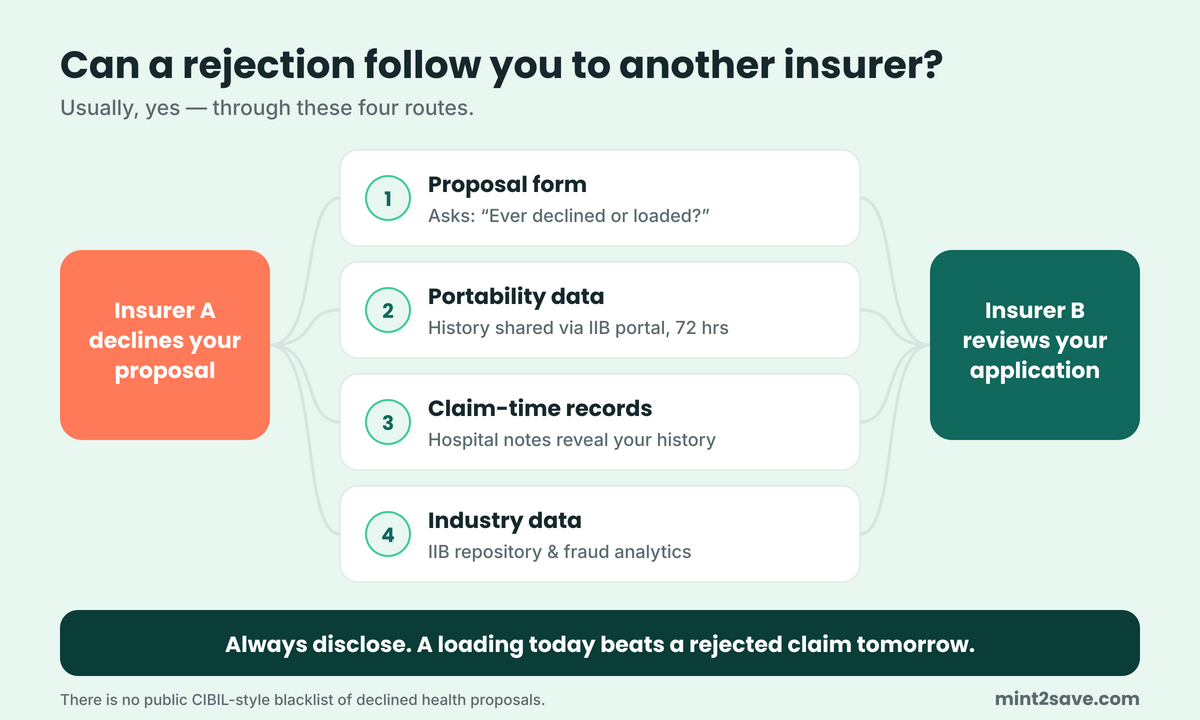
Many people assume that if one insurer turns them down, the next insurer won’t find out. Here is how the information actually travels.
1. The proposal form asks you directly
Most proposal forms ask a question like:
“Has any insurer ever declined, postponed, loaded or imposed special conditions on a proposal for life, health or critical illness cover?”
You are legally required to answer truthfully. Your answer becomes part of the contract. If you hide a previous rejection or loading, the insurer can treat it as non-disclosure of a material fact. Within the first 5 years (before the moratorium), this can lead to a rejected claim or a cancelled policy. After the moratorium, only fraud can be used against you.
Indian courts have generally upheld insurers in cases where proposers hid previous policies or declined proposals that the form specifically asked about.
2. Portability: your policy history is shared officially
When you port, you sign a portability form that authorises the new insurer to get your previous policy and claim details. Under IRDAI’s process, the new insurer requests this through a portal run by the Insurance Information Bureau of India (IIB). The old insurer must reply within 72 hours, and the new insurer must decide within 5 days of receiving the data.
So when you port, the new insurer sees your previous policy terms, loadings and claims history.
3. Records come out at claim time
When you claim, the insurer reads hospital records, discharge summaries and doctors’ notes. These usually show how long you have had a condition. If the records show a condition you did not declare, the claim can be challenged, regardless of what any database shows.
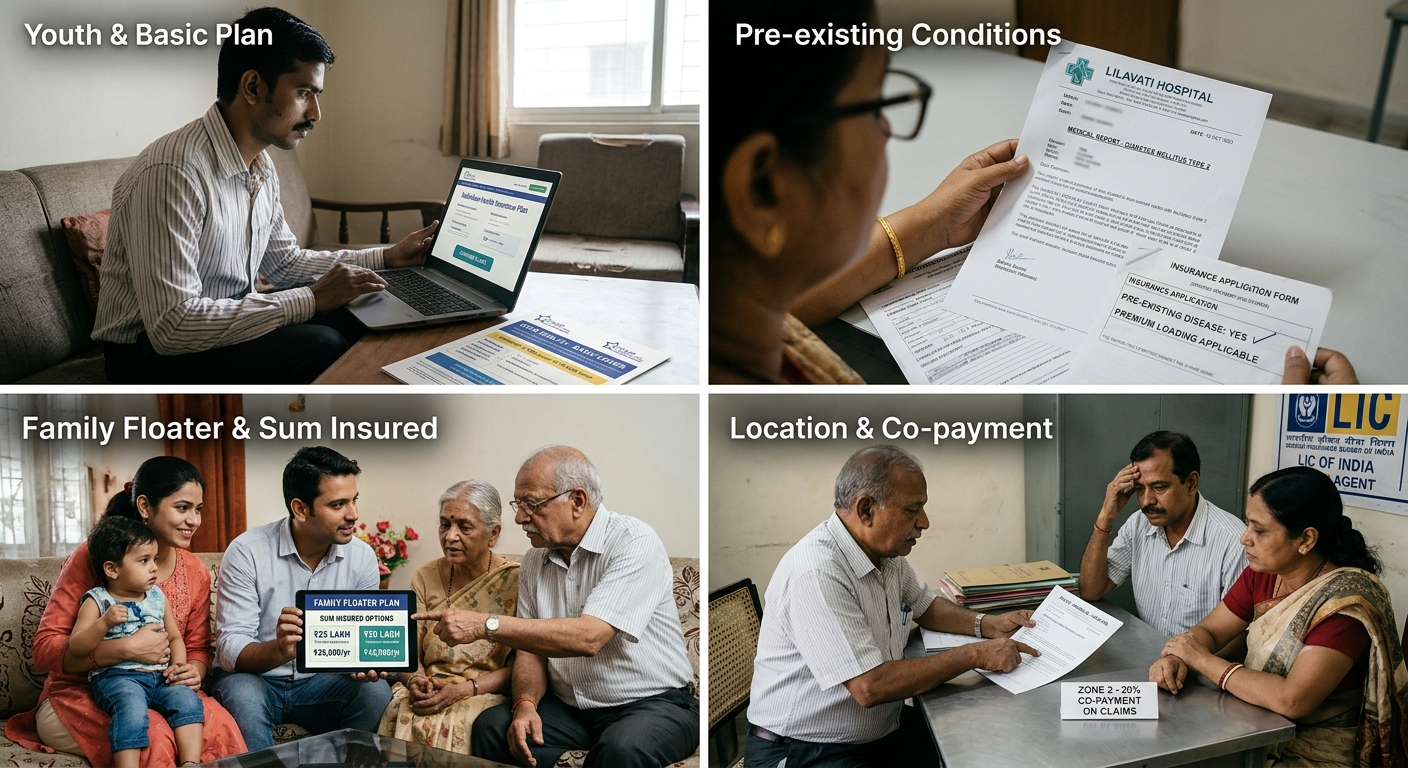
4. Industry data and fraud checks
IIB was set up at IRDAI’s initiative as the industry’s data repository. It collects policy and claims data from insurers for pricing, analysis and fraud detection, and it maintains ROHINI, a registry of network hospitals. There is no public, CIBIL-style blacklist of people whose health proposals were declined. Even so, a previous rejection is very likely to come to light through your own answers, portability data or your medical records.
What to do if you are declined
- Ask for the reasons in writing. IRDAI expects insurers to communicate proposal decisions in writing (the service standard is 7 days), and a refusal should come with reasons.
- Disclose it on your next application. A loading or exclusion you accept openly is much better than a claim rejected later.
- Try other routes. Options include Arogya Sanjeevani, policies designed for specific conditions (such as diabetes or cardiac cover), employer group cover or a government scheme (Part 6).
- Complain if you were treated unfairly. Go to the insurer’s grievance officer first; insurers must act on complaints within 14 days. If unresolved, escalate to IRDAI’s Bima Bharosa portal or the Insurance Ombudsman.
Part 6: Government health schemes you may already have
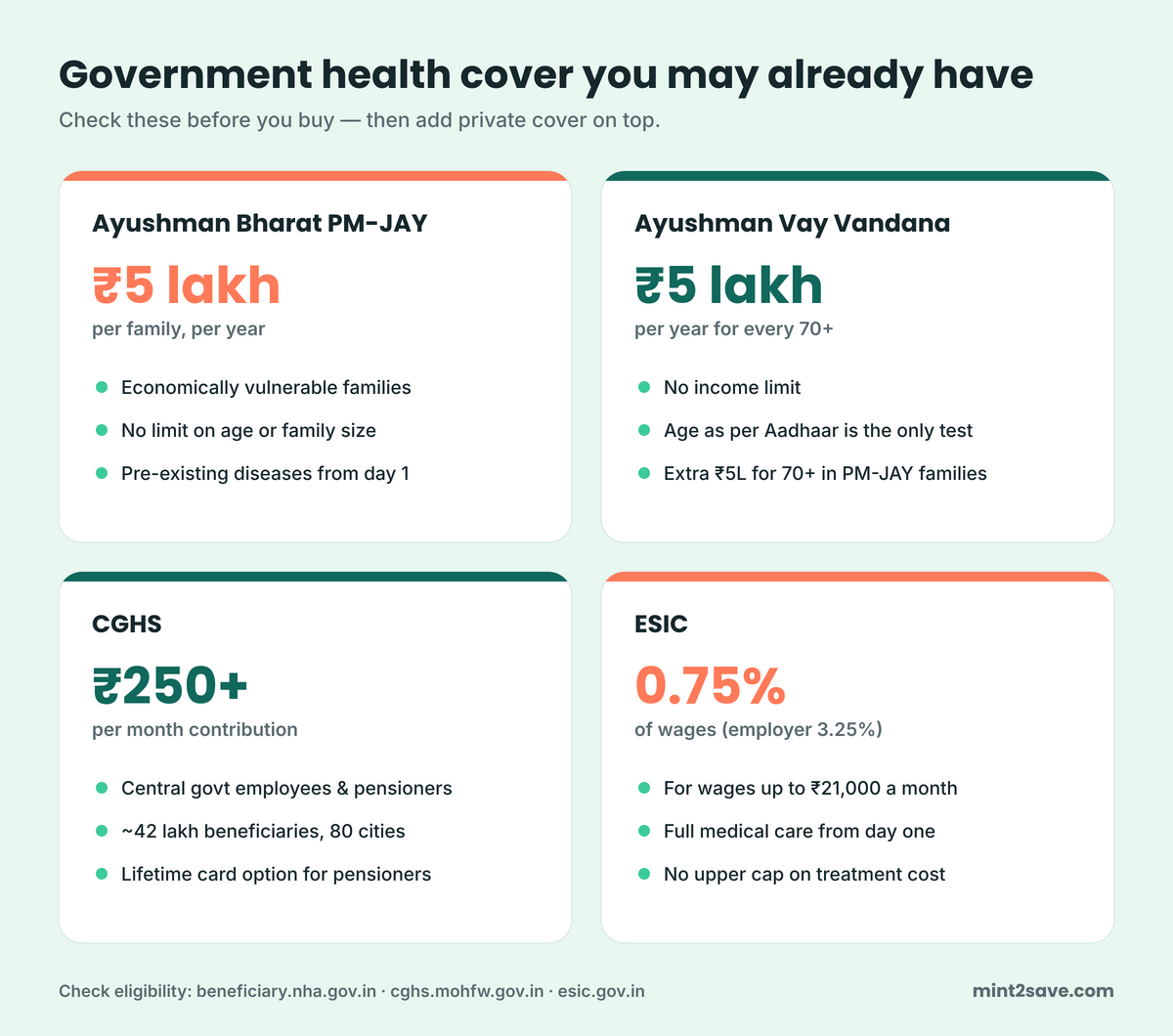
Before buying, check whether you or your parents are already covered. A government scheme can be your base cover, with private insurance adding to it.
Ayushman Bharat PM-JAY
- ₹5 lakh per family per year for secondary and tertiary hospitalisation
- Covers about 12 crore economically vulnerable families, roughly the bottom 40% of the population
- No limit on family size or age, and pre-existing diseases are covered from day one
- Cashless treatment at empanelled public and private hospitals anywhere in India
Ayushman Vay Vandana: every senior citizen aged 70+
- Launched in October 2024. Every Indian aged 70 or above is eligible for ₹5 lakh a year, regardless of income
- Eligibility is based only on age as recorded in Aadhaar; enrolment requires Aadhaar e-KYC
- For families already under PM-JAY, members aged 70+ get an extra ₹5 lakh for themselves
- If both grandparents are 70+, the ₹5 lakh is shared between them (it is family-based)
- No waiting period; cover starts from the day of enrolment
- People with private insurance or ESI can still enrol
- CGHS, ECHS and CAPF members must choose between their current scheme and PM-JAY
- Apply at beneficiary.nha.gov.in or through the Ayushman app
What this means for you: For parents aged 70 or more, enrol them in Vay Vandana first, then add a private policy or super top-up for higher cover and a wider choice of hospitals.
CGHS (central government employees and pensioners)
- Covers about 42 lakh beneficiaries in 80 cities
- Monthly contribution by pay level: ₹250 (Levels 1–5), ₹450 (Level 6), ₹650 (Levels 7–11), ₹1,000 (Level 12+)
- Pensioners can pay once for lifetime cover (₹30,000 to ₹1,20,000)
- If you also have private insurance, the total reimbursed from both cannot exceed the actual bill
ESIC (lower-wage employees in the organised sector)
- Covers employees earning up to ₹21,000 a month in covered establishments
- Employee pays 0.75% of wages and the employer pays 3.25%
- Full medical care for the worker and dependants from day one, with no upper limit on treatment cost, plus cash benefits for sickness and maternity
State schemes
Many states run their own schemes or add to PM-JAY. For example, when Delhi adopted PM-JAY it announced an additional ₹5 lakh top-up. Check your state health department’s website for what applies to you.
How government and private cover work together
| Your situation | A sensible setup |
|---|---|
| Young salaried, employer cover only | Own base policy + super top-up (employer cover ends when you leave the job) |
| Parents aged 70+ | Vay Vandana + private senior policy or super top-up |
| CGHS member | CGHS + optional private super top-up for higher cover |
| ESIC member | ESIC for routine care; consider a small private policy for choice of hospital |
| PM-JAY family | PM-JAY + Arogya Sanjeevani or a top-up if you can afford it |
Quick FAQ
Will one claim increase my renewal premium? It should not, on its own. IRDAI bars loading individual renewal premiums because of your own claims. You may lose part of your cumulative bonus.
Why did my premium rise even though GST was removed? Removing GST cut the tax part. The insurer can still revise base rates for medical inflation, and you may have moved into a new age band.
Can my 72-year-old father get cover? Yes. He can enrol in Ayushman Vay Vandana free of cost, and IRDAI no longer allows an upper age limit to stop people from buying private cover.
I was declined by one insurer. Should I mention it to the next? Yes, always. Hiding it can lead to a rejected claim later. Disclosing it may mean a loading or exclusion, but your cover will hold up when you claim.
This article is for general information and education. It is not insurance, tax or financial advice. Policy terms differ by insurer, and government scheme rules change, so check the policy wording and official portals, or speak to a licensed advisor, before you decide.
Related Posts


Subscribe to get the best of finance and fintech. Regularly.
Categories
Popular

- 31 May 2016 | 18620 Views
- 16 June 2020 | 16023 Views
- 19 May 2021 | 15528 Views

- 14 May 2021 | 12291 Views
Recent

- 12 November 2026

- 11 November 2026
- 10 November 2026