
Digital Arrest Scam in India: How to Spot It and Verify a Call
- 12 November 2026 | 38 Views | By Mint2Save
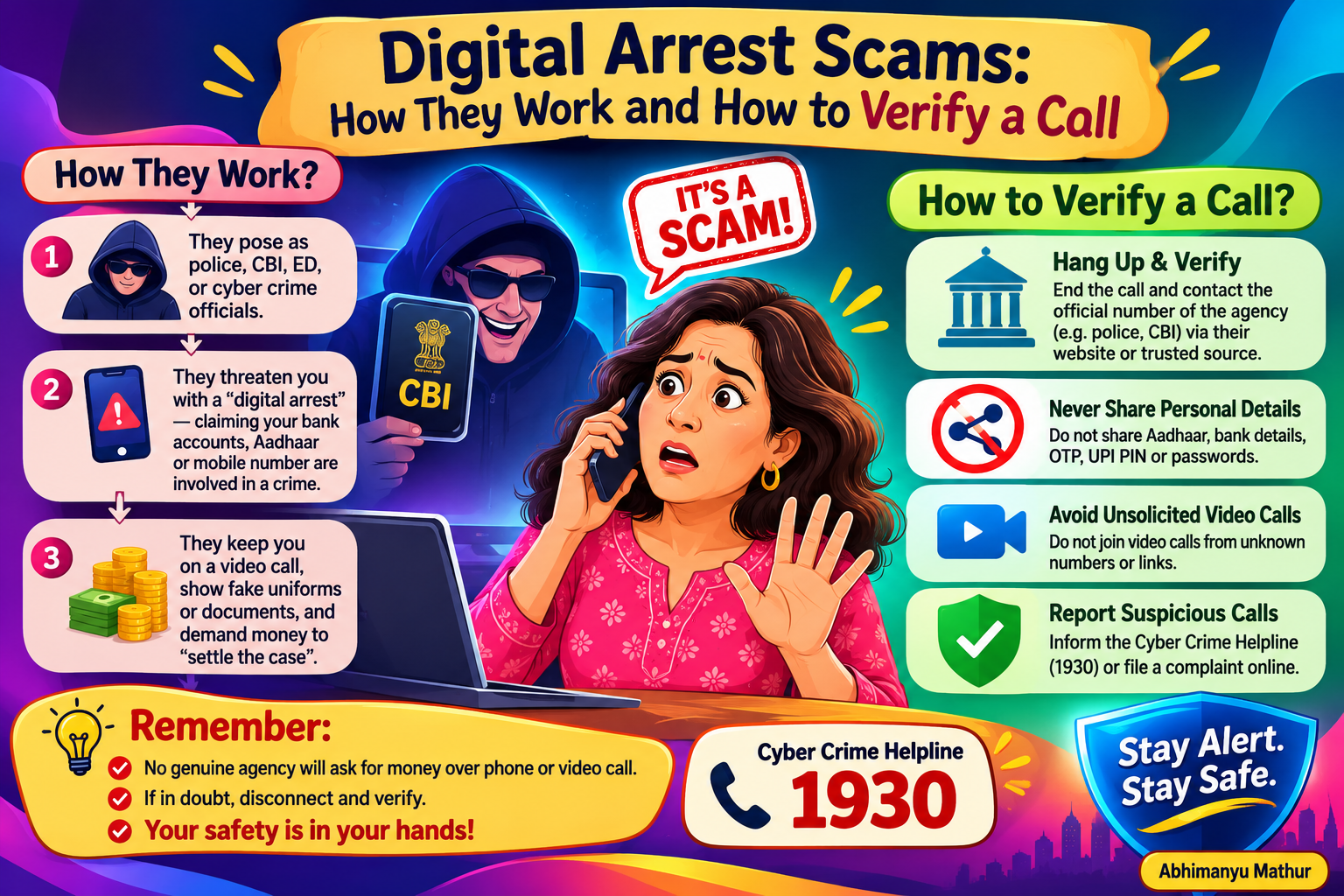
The 36 hours Mrs. Deshpande lost
The story below is fictional. Every tactic in it comes from real cases described in government advisories.
At 10:14 on a Tuesday morning, Sunanda Deshpande’s phone rang. She is a 67-year-old retired schoolteacher in Pune. A recorded voice said a courier parcel in her name had been held at Mumbai customs. “Press 9 to speak to an officer.”
She pressed 9. A polite man said the parcel was going to Taiwan and held five passports, three credit cards and 200 grams of MDMA. It was booked with her Aadhaar number, and he read out all twelve digits. Sunanda’s stomach dropped. She had never sent a parcel to Taiwan.
“Madam, this is serious. I will connect you to Mumbai Cyber Crime so you can file a complaint before they come to you.”
The next voice belonged to “Inspector Rathod.” He asked her to switch to a WhatsApp video call “for verification.” On screen she saw a man in khaki at a desk. Behind him hung a state emblem, and walkie-talkies crackled in the background. He showed her an FIR with her name on it. Then he said her Aadhaar was linked to a ₹68 crore money-laundering case, now taken over by the CBI.
From that moment, Sunanda was “under digital arrest.”
She was told to keep the camera on at all times and to tell no one. Her son in Bengaluru might be “involved” too, they said, so calling him would “compromise the investigation.” A PDF arrived with a Supreme Court seal: an order to move her savings into a “RBI-supervised safe account” for verification. Clean money would be returned within 48 hours, they promised.
She slept with the phone propped against a water glass. The next afternoon she went to her bank and transferred ₹23.4 lakh, her fixed deposits and most of her pension savings. When the branch manager asked about the large transfer, she said it was for a family property purchase. The “inspector” had told her exactly what to say.
On the evening of day two, the video call simply ended. The WhatsApp number stopped working. Sunanda’s son called that night, worried that she had not answered for two days. Only then did she tell someone.
She is not careless and she is not foolish. She was the target of a scripted operation built to beat exactly the kind of person who respects the law.
What a “digital arrest” really is?
A digital arrest is extortion that dresses up as legal process. Criminals pose as officers of the CBI, Enforcement Directorate, Customs, police, Narcotics, or even the RBI. They accuse you of a serious crime and keep you on a video call until you pay. NITI Aayog describes it as a scam that runs on fear and intimidation and notes how quickly it spread in 2024 (NITI Aayog).
The legal position is simple. No Indian law lets anyone arrest you through a video call. In his Mann Ki Baat broadcast of 27 October 2024, the Prime Minister said there is no system of digital arrest under the law, and that no agency will contact you by phone or video for such an investigation. The RBI’s public message makes the same point: there is no such thing in law, do not share details or pay, and call 1930.
The numbers show why this matters. In a written reply to the Rajya Sabha in March 2025, the Home Ministry reported these complaints on the National Cyber Crime Reporting Portal:
| Year | Digital arrest complaints | Amount defrauded |
|---|---|---|
| 2022 | 39,925 | ₹91.14 crore |
| 2023 | 60,676 | ₹339 crore |
| 2024 | 1,23,672 | ₹1,935.51 crore |
| 2025 (Jan–Feb) | 17,718 | ₹210.21 crore |
That is roughly 3x more cases and 20x more money lost in two years. The same reply said I4C had blocked more than 83,668 WhatsApp accounts and 3,962 Skype IDs used for digital arrests (PIB, MHA). Awareness is starting to work: a Securonix analysis cites MHA data showing cases fell by about 86% in 2025. But the gangs keep adapting, so the playbook is still worth learning.
How the scam works, step by step
Sunanda’s ordeal followed a script. The Indian Cyber Crime Coordination Centre’s advisory of 6 March 2025 calls digital arrest an organised economic crime and lays out the same four stages every time.
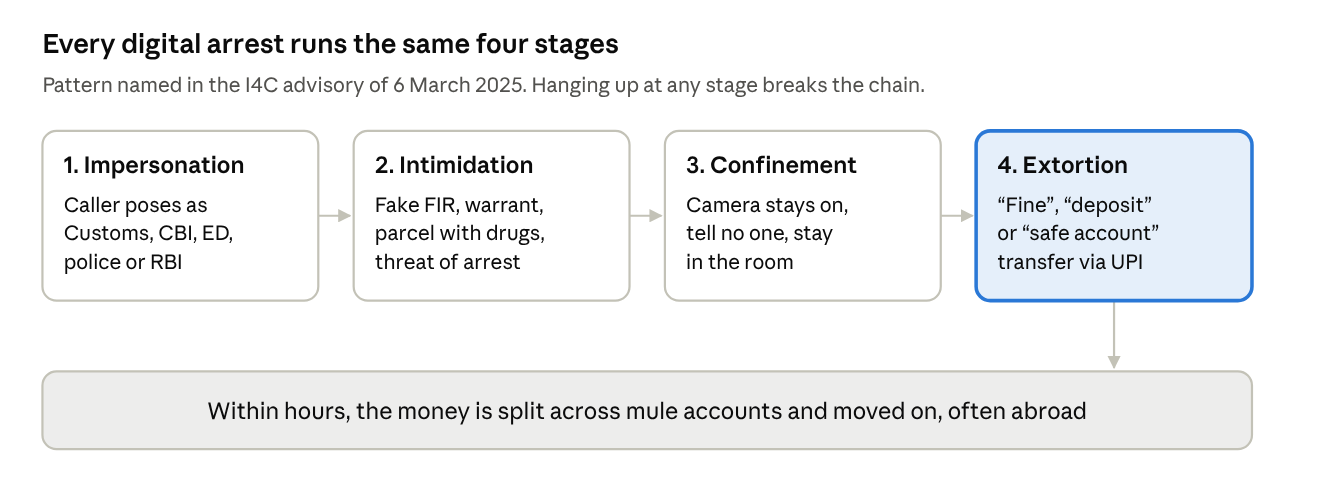
The props are convincing. Scammers use uniforms, staged police-station backdrops and forged letters with Home Ministry or RBI seals. In the case of Vardhman Group chairman S.P. Oswal, who lost ₹7 crore over two days in 2024, the gang held a fake Supreme Court hearing on Skype with a deepfake judge.
The Ultimate Secret Of Cyber Security in Banking
Why smart, careful people fall for it
This scam does not hack your phone. It hacks your judgement. Victims include doctors, engineers, retired officers and business owners, and the script exploits five very human reflexes:
- Respect for authority. Most of us cooperate with someone who appears to be from the police or a court.
- Fear of shame. A drug or money-laundering charge feels like a threat to your family’s reputation, so you want it fixed quietly.
- Manufactured urgency. “Arrest in two hours” leaves no room to stop and check.
- Isolation. “Don’t tell anyone” removes the one thing that breaks the spell: a second opinion.
- Uncanny detail. Your Aadhaar number, address or bank name, taken from leaked data, makes the caller seem all-knowing.
The Prime Minister’s three-step advice is the antidote: Ruko, Socho, Action Lo. Stop, think, then act. Panic is the scammer’s main tool, and a pause takes it away.
How to verify a call in under five minutes
The I4C’s advice fits in one line: police, CBI, Customs, ED and judges do not arrest anyone on a video call. Keep that in mind, and the scam falls apart as soon as you spot one of these lines.
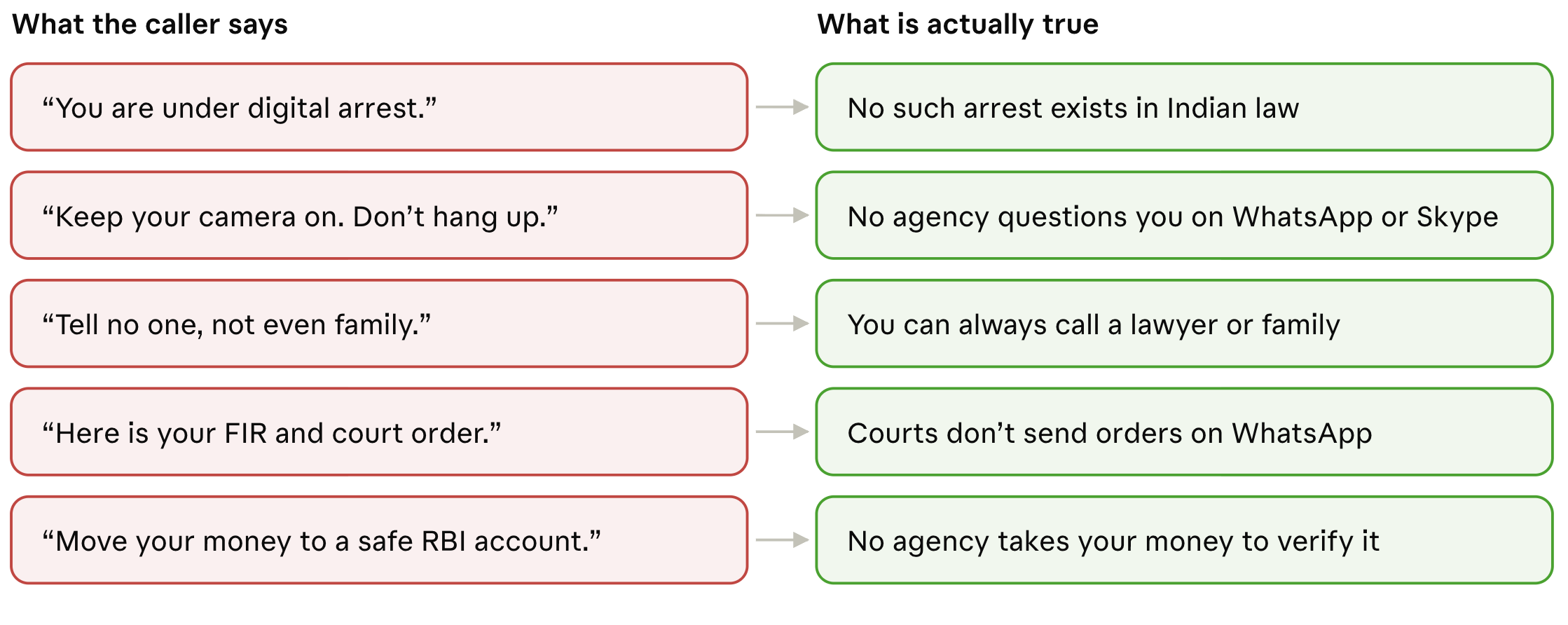
If you are still unsure, follow these steps. None of them needs the caller’s help.
- Hang up. A real officer has no problem with you ending a call. You do not have to stay on the line, keep a camera on, or stay in a room.
- Ignore the caller ID. Numbers can be spoofed, so a “police” or “+91” number proves nothing. Never call back a number they give you or join a “senior officer” they transfer you to.
- Find the official number yourself. Dial 112, or walk into your nearest police station with whatever details they gave you. For a notice claiming to be from the CBI, check it on the CBI’s ABHAY chatbot, launched in April 2026 to verify CBI notices.
- Check the story at its source. For a “held parcel,” use the courier company’s official app or website. For a “blocked SIM,” check your connections on Sanchar Saathi. For a bank or KYC issue, call the number on the back of your card.
- Tell someone right away. Call a family member, friend or your bank branch. If a call ever tells you to keep a secret, that is the clearest sign it is a scam.
- Never pay to “verify” or “clear” anything. No agency parks your savings in a “safe account” or takes a fine over UPI, crypto or gift cards.
- Report the attempt. Even if you lost nothing, report the number on Chakshu, under Citizen Centric Services on the Sanchar Saathi portal, within 30 days. It helps the Department of Telecommunications cut off the number before it reaches the next person.
Already paid? Act within the golden hour
Speed matters more than anything else. Stolen money is split across mule accounts within hours, but a fast report can get it frozen before it moves on.
- Call 1930 at once, the national cyber fraud helpline, or file at cybercrime.gov.in. Have the transaction IDs, amounts and the receiving account or UPI IDs ready.
- Call your bank’s fraud line and ask them to flag the transfer and block further debits.
- Keep all the evidence. Save screenshots of chats, numbers, “official” documents and payment receipts. Do not delete the WhatsApp thread.
- File an FIR at your local police station using the complaint number from the portal.
- Beware of “recovery agents.” Anyone who promises to get your money back for a fee is usually the second half of the same scam.
If Sunanda’s son had called 1930 that night, with the transfer just a few hours old, her bank would have had a real chance to hold part of it. And if this happens to someone you love, don’t blame them. NITI Aayog makes the same point: victims who feel judged stay silent, and silence protects the gang.
The one rule to share with your parents tonight
The gangs behind digital arrests spend weeks perfecting their uniforms, seals and scripts. You only need one sentence to beat them:
A real officer will never arrest you on a video call, never ask you to keep it secret, and never ask you to transfer money. Hang up and dial 1930.
Save it, print it, and forward it to the family WhatsApp group, especially to anyone over 60 who lives alone. Scams like this succeed in silence and fail as soon as people talk about them.
Related Posts


Subscribe to get the best of finance and fintech. Regularly.
Categories
Popular

- 31 May 2016 | 18607 Views

- 16 June 2020 | 16014 Views

- 19 May 2021 | 15517 Views

- 14 May 2021 | 12280 Views
Recent
- 12 November 2026

- 11 November 2026
- 10 November 2026