
Inflation Calculator India: What Will ₹1 Crore Really Be Worth? (Inflation Time Machine, 2026)
- 20 November 2026 | 44 Views | By Mint2Save
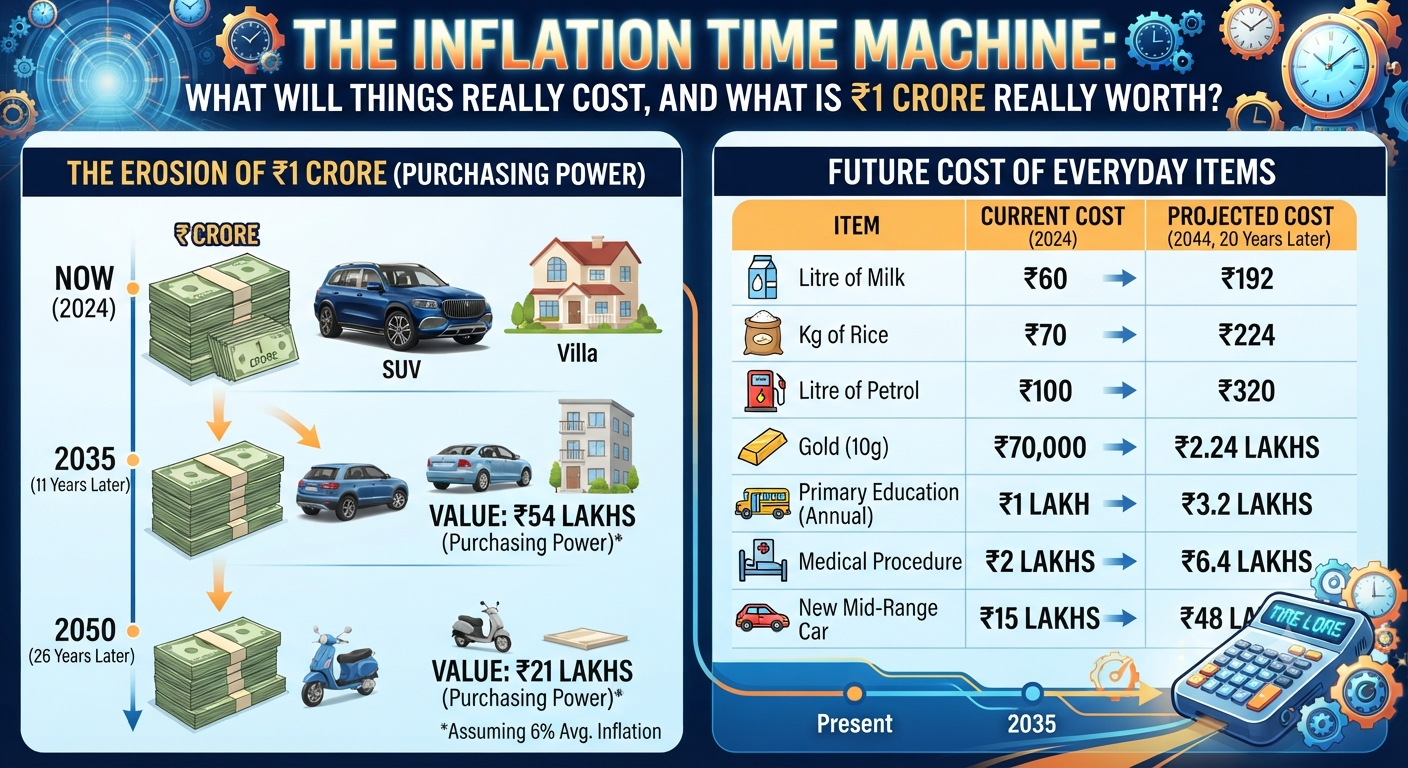
The Inflation Time Machine: What Will Things Really Cost, and What Is ₹1 Crore Really Worth?
A plain-language guide to inflation, with worked examples and a free calculator
Someone tells you that if you invest ₹10,000 a month, you will have ₹1 crore in 20 years. It sounds like a lot of money, and it is, today. But you won’t be spending it today. You will be spending it in 2046, when a litre of milk, a hospital room and a year of college all cost far more than they do now.
That is the problem inflation creates for every financial plan. The number on the screen is in future rupees. Your life is priced in today’s rupees. Unless you convert one into the other, you can’t tell whether a plan is enough.
That is what the Inflation Time Machine on Mint2Save does. It works in both directions:
- ⏩ What will it cost later? Enter a cost today and see what it will cost in a few years.
- ⏪ What is a future amount worth today? Enter a big future number and see what it really buys in today’s money.
This guide explains how it works, shows worked examples, and covers the mistakes people make when planning for inflation.
Part 1: What inflation actually does to your money
Inflation is the rate at which prices rise. If inflation is 6%, something that costs ₹100 this year will cost about ₹106 next year.
That sounds small. The problem is that it compounds: each year’s increase is applied on top of the previous year’s higher price, not on the original price. Over long periods, the effect is large.
How much prices multiply over time
| Inflation rate | After 10 years | After 20 years | After 30 years |
|---|---|---|---|
| 4% | 1.48× | 2.19× | 3.24× |
| 6% | 1.79× | 3.21× | 5.74× |
| 8% | 2.16× | 4.66× | 10.06× |
| 10% | 2.59× | 6.73× | 17.45× |
| 12% | 3.11× | 9.65× | 29.96× |
Read the 6% row. At an inflation rate that sounds ordinary, prices more than triple in 20 years and nearly sextuple in 30. At 10%, which is close to what many families see in school fees and hospital bills, prices rise more than 17 times in 30 years.
A quick shortcut: the Rule of 72
To estimate how long it takes for prices to double, divide 72 by the inflation rate.
- At 6%, prices double in about 12 years.
- At 8%, in about 9 years.
- At 12%, in about 6 years.
So if your child is 6 and school fees rise 12% a year, fees will be roughly double by the time they turn 12, and roughly four times today’s level by 18.
Part 2: Not everything inflates at the same speed
The inflation number you read in the news is the CPI (Consumer Price Index) published every month by the Ministry of Statistics and Programme Implementation (MoSPI). It tracks a weighted basket of what an average household buys: food, housing, clothing, transport, healthcare, education and more. Since 2026, the series uses 2024 as its base year.
For October 2026, MoSPI reported retail inflation of 6.09% (provisional), up from 5.54% in September, with food inflation at 8.94%. That reading crossed the upper limit of the RBI’s tolerance band. The RBI’s target is 4%, with a band of 2% to 6%.
But the CPI is an average. Your own costs may rise much faster, depending on what you spend on. Two categories in particular run well ahead of headline inflation:
Healthcare. Aon’s medical trend report projects that employee medical plan costs in India will rise 11.5% in 2026 and 10.1% in 2027, more than twice the rate of general inflation. That is why health insurance renewals keep going up.
Education. The official CPI shows education inflation in a modest range, but fees at private schools tell a different story. Research from 1 Finance found that schools in Mumbai, Delhi, Pune, Hyderabad and Bengaluru commonly raise fees by 10–12% a year, and some Mumbai schools raised fees by about 18% in a single year. CMIE’s household survey found that education spending grew at about 15.7% a year over the past decade, faster than household incomes (about 11.9%).
This is why the Inflation Time Machine asks “What kind of expense?” before it calculates. It has separate preset rates for:
- Everyday living — groceries, rent, transport, utilities
- Education — school fees, college, coaching
- Healthcare — hospital bills, medicines, insurance premiums
- Weddings & lifestyle — gold, venues, travel, big celebrations
- My own rate — type in any rate you want
The presets are planning assumptions, not forecasts. If you know your child’s school raises fees by 15% a year, choose “My own rate” and enter 15.

Part 3: How to use the Inflation Time Machine
Mode 1: ⏩ What will it cost later?
Use this when you know what something costs today and want to know what you will need in the future.
- Enter the Cost today.
- Enter Years from now.
- Choose What kind of expense? (or set your own rate).
- Check the Inflation rate (% a year) and adjust it if you want.
The results table shows the Item, its cost Today, its cost Then, and the Rate used, so you can see exactly what assumption produced the answer.
Mode 2: ⏪ What is a future amount worth today?
Use this when someone shows you a big future number (a maturity value, a retirement corpus, a policy payout) and you want to know what it is really worth.
Enter the future amount and the number of years, and the calculator converts it back into today’s money.
The formula behind it
The calculator uses compound inflation:
Future cost = Today’s cost × (1 + rate) ^ years
Value in today’s money = Future amount ÷ (1 + rate) ^ years
There is nothing hidden. You can check any result yourself on a phone calculator.
Part 4: Worked examples
All rates below are assumptions chosen for illustration. Use the calculator with the rates that fit your situation.
Example 1: Is ₹1 crore in 20 years really ₹1 crore?
| Assumed inflation | What ₹1 crore in 20 years is worth today |
|---|---|
| 5% | about ₹37.7 lakh |
| 6% | about ₹31.2 lakh |
| 7% | about ₹25.8 lakh |
At 6% inflation, ₹1 crore in 20 years buys roughly what ₹31 lakh buys today. Stretch it to 25 years and it falls to about ₹23 lakh.
That doesn’t make ₹1 crore a bad goal. It means you should judge it as a ₹31 lakh goal, not a ₹1 crore one, when deciding whether it is enough for what you want to do with it.
Example 2: Your child’s college fund
A professional degree costs ₹20 lakh today. Your child will start college in 15 years. At 10% education inflation, the same degree will cost about ₹83.5 lakh.
If you are saving towards ₹20 lakh, you are saving for less than a quarter of the real bill.
Example 3: A hospital bill in retirement
A major surgery costs ₹3 lakh today. You expect to need cover for something similar in 20 years. At 10% medical inflation, the same treatment would cost about ₹20 lakh.
This is one reason a ₹5 lakh health cover that feels comfortable today may be thin in your sixties. (See our guide on how health insurance premiums are decided for how top-ups can fill this gap cheaply.)
Example 4: Your monthly expenses at retirement
Your household spends ₹50,000 a month today. You plan to retire in 25 years. At 6% inflation, you will need about ₹2.15 lakh a month to live the same way.
Your retirement corpus has to fund that number, every month, and keep up with inflation after you retire too.
Example 5: A wedding
A wedding budget of ₹15 lakh today becomes about ₹37.8 lakh in 12 years at 8% a year.
Part 5: Why inflation matters for where you keep your money
Inflation doesn’t only raise your future costs. It also eats into your savings.
Suppose you put ₹10 lakh in a deposit earning 7% a year for 20 years. On paper, it grows to about ₹38.7 lakh. Adjust for 6% inflation and it is worth about ₹12.1 lakh in today’s money. Your real gain over 20 years is roughly ₹2 lakh of purchasing power.
Now add tax. If you are in the 30% bracket, a 7% deposit earns about 4.9% after tax. After 20 years at 6% inflation, your ₹10 lakh is worth about ₹8.1 lakh in today’s money. You have lost purchasing power while the balance appeared to grow.
The figure that matters is the real return:
Real return ≈ Return after tax − Inflation
This is not an argument for or against any product. Deposits are safe and liquid, and that has value, especially for emergency funds and short-term goals. It is an argument for checking the real return before you decide where long-term money goes.
Part 6: Common mistakes when planning for inflation
1. Using one rate for everything. Groceries, school fees and hospital bills don’t rise at the same pace. Plan each goal at its own rate.
2. Planning with today’s prices. “I need ₹20 lakh for my daughter’s education” is a today’s-money number. The goal is what it will cost when she enrols.
3. Trusting nominal returns. A product that “doubles your money” in 10 years earns about 7% a year. At 6% inflation, that is barely ahead.
4. Forgetting that inflation continues after retirement. If you retire at 60 and live to 85, your expenses keep rising for 25 more years. A fixed monthly income loses value every year.
5. Treating a high-inflation month as the new normal (or a low one). Inflation was 0.25% in October 2025 and 6.09% in October 2026. Single months swing. For long-term plans, use a steady long-run assumption and check it once a year.
6. Ignoring lifestyle inflation. As income rises, people often spend more on better schools, bigger homes and more travel. That isn’t price inflation, but it raises your future needs in the same way. The “My own rate” option lets you plan for it.
Quick FAQ
What inflation rate should I use for long-term planning in India? There is no single right answer. Many planners use around 6% for general household expenses, and 8–12% for education and healthcare. The RBI’s target is 4%, but the actual rate has often been higher. If unsure, run the calculator at two or three rates and plan for the higher result.
Why does my own experience of inflation feel higher than the CPI number? The CPI is an average basket for the whole country. If a large part of your spending goes on private school fees, metro rents or private healthcare, your personal inflation rate may be well above the official number.
Is the calculator’s result exact? No. It is a planning estimate. Actual inflation changes every year, and the preset rates are assumptions. The calculator is most useful for comparing scenarios and setting realistic targets.
Does the calculator account for tax or investment returns? No. It only adjusts for inflation. To see whether an investment beats inflation, compare its after-tax return with the inflation rate you used.
Can I use it for amounts outside India? The formula works for any currency. The preset rates and example prices are designed for Indian households, so if you live elsewhere, choose “My own rate” and enter your local inflation rate.
Try it now
Open the Inflation Time Machine and run three numbers:
- Your monthly household expenses, 20 years from now.
- Your biggest goal (a child’s education, a home, retirement), at its own inflation rate.
- The maturity value of any policy or investment you hold, converted back into today’s money.
If any of those results surprise you, that is the point. It is better to be surprised now, when you still have years to adjust, than at the point you need the money.
This article is for general information and education. It is not investment, tax or financial advice. Inflation rates used in the examples are assumptions for illustration; actual inflation varies from year to year. Speak to a SEBI-registered investment adviser before making investment decisions.
Related Posts



Subscribe to get the best of finance and fintech. Regularly.
Categories
Popular

- 31 May 2016 | 18633 Views

- 16 June 2020 | 16035 Views

- 19 May 2021 | 15543 Views

- 14 May 2021 | 12307 Views