
Cheapest Way to Send Money to India from the UAE, US and UK, Compared (2026)
- 17 November 2026 | 60 Views | By Mint2Save
Two people send $1,000 home on the same day. One family receives about ₹93,500. The other receives about ₹87,000. Neither sender was cheated. One used an app that charges close to the market rate. The other used an ordinary bank wire with a fixed fee and a weak exchange rate.
India receives more remittances than any other country, yet many senders still pick a channel out of habit. This guide compares the main options in the three biggest corridors (UAE, US and UK) and shows you how to check the price yourself every time you send.
Part 1: How the price of a transfer really works
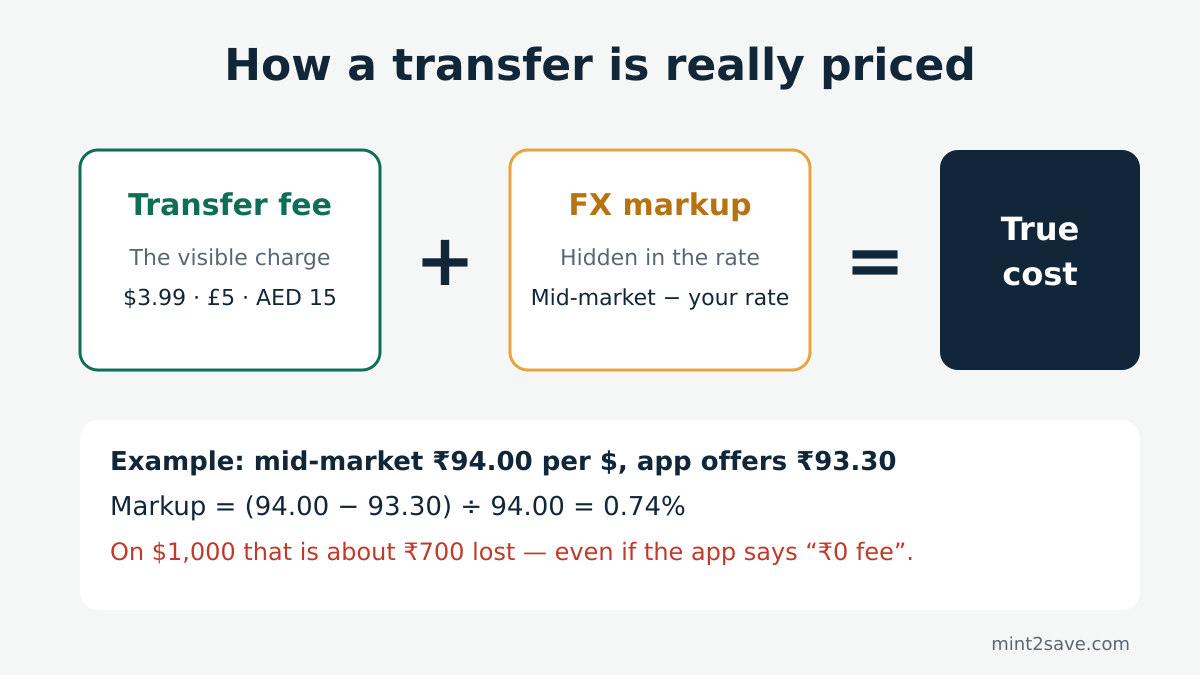
Every transfer has two costs:
Total cost = Transfer fee + Exchange-rate markup
1. The transfer fee. This is the visible charge, for example $3.99, £5 or AED 15.
2. The exchange-rate markup. This is the hidden cost. The mid-market rate is the rate you see on Google or Reuters, the midpoint between what banks pay to buy and to sell a currency. Most providers give you a slightly worse rate and keep the difference.
A provider that says “zero fee” almost always earns through the rate. A provider that uses the mid-market rate earns through a visible fee. Neither model is automatically cheaper. What matters is the final number:
The cheapest provider is the one that delivers the most rupees for the same amount sent.
How to calculate the markup yourself
Markup (%) = (Mid-market rate − Rate offered) ÷ Mid-market rate × 100
Example: if the mid-market rate is ₹94.00 per dollar and an app offers ₹93.30, the markup is 0.70 ÷ 94 = 0.74%. On $1,000 that is about ₹700 lost in the rate, even if the app shows “₹0 fee”. Decoding the Real Effective Exchange Rate (REER): A Guide
What the averages say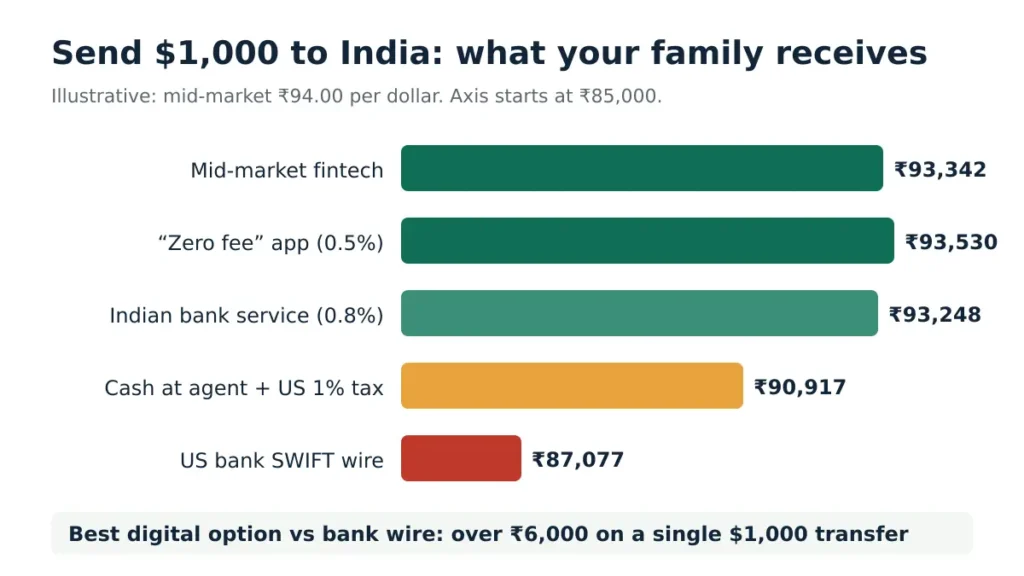
The World Bank tracks remittance prices worldwide. In the first quarter of 2025, the global average cost of sending $200 was 6.49%. The UAE–India corridor is far cheaper: the World Bank recorded an average total cost of 3.68% in the same quarter, of which 0.72% was exchange-rate margin. These averages include expensive channels. The best digital options today cost well under 1%.
Part 2: The five kinds of channel
| Channel | Examples | Typical all-in cost | Best for |
|---|---|---|---|
| Mid-market fintech | Wise, Aspora, Revolut (within plan limits) | About 0.3–1% | Regular transfers of any size, full transparency |
| Rate-margin remittance app | Remitly, Xoom, Taptap Send, Xe, Western Union digital | About 0.3–1.5% if funded from a bank account | Fast delivery, UPI and cash payout, first-transfer offers |
| Indian bank remittance service | ICICI Money2India and similar bank-run services | Small or zero fee + rate markup | People who prefer a bank brand, larger amounts |
| Gulf exchange house | LuLu Money, Al Ansari, e& money | Zero to about AED 26 fee + thin margin | UAE senders, branch or app, cash payment |
| Your local bank’s SWIFT wire | Chase, Barclays, Santander, UAE banks | Often 2–7% on smaller amounts | Very large or compliance-heavy transfers only |
Two things push costs up in every channel:
- Paying by credit card. Card-funded transfers often carry extra fees, and your card issuer may treat them as cash advances.
- Cash pickup. A 2026 FXC Intelligence study across ten US corridors found cash payouts cost about 0.7 percentage points more on average than bank-account payouts.
Part 3: From the United States
First, the new US tax on cash remittances
Since 1 January 2026, the US charges a 1% federal excise tax on remittances that are funded with cash, a money order or a cashier’s check. Transfers funded from a US bank account or a US-issued debit or credit card are exempt. The Treasury and IRS published proposed regulations in April 2026, but the tax itself has applied since 1 January.
What this means for you: never fund a transfer to India with cash if you can link your bank account instead. On $1,000, cash funding adds $10 before any fee or markup.
The main options
| Provider | Fee (bank-funded, to a bank account) | Exchange rate | Notes |
|---|---|---|---|
| Wise | Visible fee with a fixed part and a percentage: about 0.7% on $1,000, higher in percentage terms on small amounts, lower on large ones | Mid-market, no markup | Delivers to Indian bank accounts and UPI |
| Remitly | $3.99 below $1,000; $0 from $1,000 up | Markup inside the rate; independent measurements range from about 0.3% to 1.4% | Better promotional rate on the first transfer |
| ICICI Money2India | $4 below $1,000; $0 from $1,000 up | ICICI’s own rate, which includes its margin | Open to non-ICICI customers; no charge to the recipient |
| Xoom (PayPal) | $0 from a bank account; about $6 by debit card; much more by credit card | Markup typically 1–3% | Bank, UPI and cash pickup |
| US bank wire (Chase, Wells Fargo, BoA) | Outgoing wire fee, often $25–50 | Markup often 2–5% | Generally the most expensive route for normal amounts |
What the live comparisons show:
- On Wise’s own comparison for sending $350, Wise charged an $8.54 fee at the mid-market rate, against a $11.39 hidden markup at Wells Fargo and a $15.99 total cost at Chase.
- On Remitly’s own comparison for $1,000, Remitly delivered ₹95,270 with no fee. Wise charged $6.85 at a mid-market rate of 95.8361, which works out to about ₹95,180. At that moment, Remitly was ahead by roughly ₹90.
The lesson: at $1,000 and above, Remitly-style “zero fee” apps and Wise are often within a few hundred rupees of each other, and the winner changes from day to day. Below $1,000, Remitly’s $3.99 fee and Money2India’s $4 fee make the comparison closer still. Check both quotes on the day you send.
Part 4: From the United Kingdom
| Provider | Fee | Exchange rate | Notes |
|---|---|---|---|
| Wise | About £5 on £1,000 by bank transfer | Mid-market | Volume discounts on larger amounts |
| Revolut | No exchange fee on weekdays within your plan’s monthly allowance | Revolut rate, close to mid-market | Above the allowance, a fair-usage fee applies: 1% on Standard, 0.5% on Plus. Weekend fees apply unless you pay for Premium, Metal or Ultra |
| Aspora (formerly Vance) | Up to £3 | Mid-market (“Google rate”) | India-focused, FCA-regulated |
| Remitly | Low or zero | Markup inside the rate | Fast, with UPI and cash options |
| High-street banks (Barclays, Santander, Lloyds) | £0–25 | Markup often 2–4% | Expensive for routine family support |
What a live comparison shows: for £1,000, Wise’s comparison table put its own cost at a £5.21 fee, against £27.73 hidden in Barclays’ rate, £45.60 at PayPal and £55.23 at Santander (a £25 fee plus a £30.23 markup). On that day, choosing Wise over Santander put roughly £50 (over ₹6,000) more in the recipient’s account.
Tip for Revolut users: convert and send on a weekday, and stay within your plan’s monthly allowance. Above the allowance or at the weekend, compare against Wise and Aspora before you send.
Part 5: From the UAE
The UAE–India corridor is one of the most competitive in the world. Exchange houses that once charged AED 15–25 per transfer now compete with apps that charge nothing.
| Provider | Fee | Exchange rate | Notes |
|---|---|---|---|
| LuLu Money (LuLu Exchange app) | AED 0: unlimited free transfers to India through the app (offer runs to 31 March 2027) | LuLu’s rate | Over 145 branches if you need help in person |
| Aspora | Currently no fee from the UAE | Mid-market | Partners with LuLu Exchange in the UAE |
| Taptap Send | Low fixed fee (around AED 5) | Competitive | Funded by debit card; bank and UPI payout |
| Al Ansari Exchange app | About AED 26.50 | Al Ansari’s rate | Branch network, instant credit to Indian banks |
| e& money | About AED 15.75 | e& rate | Wallet-based |
| Wise | Percentage fee, under 1% | Mid-market | Strong for larger or less frequent transfers |
| ICICI Money2India (UAE) | AED 12 | ICICI’s rate | Bank-run option |
| UAE bank SWIFT wire | Fixed fee plus correspondent charges | Bank rate, typically the weakest | Avoid for routine remittances |
What a live comparison shows: in one comparison captured in early November 2026, sending AED 25,000 through Wise cost an AED 227.58 fee and delivered about ₹6,31,048. Taptap Send charged AED 5 at a rate of 25.55 and delivered ₹6,38,750, about ₹7,700 more. On a different day or a different amount, the ranking can flip. That is why you should always compare the final rupee figure.
Two UAE-specific points:
- VAT. Remittance fees in the UAE carry 5% VAT. A “free” transfer avoids this too.
- Exchange houses vs banks. For routine monthly transfers, an exchange-house app or a fintech almost always beats a UAE bank’s SWIFT wire.
Part 6: What happens at the Indian end
Many people stop at the sending side. The receiving side matters too.
Case 1: the money arrives already in rupees
Wise, Remitly, Aspora, LuLu, Money2India and most other remittance services deliver rupees. The quote you saw before sending is what your family receives. You have no conversion charge at the Indian bank.
Case 2: the money arrives in dollars, pounds or dirhams
If you send a SWIFT wire in foreign currency, the Indian bank converts it at its own TT buying rate, which is below the mid-market rate. On top of that:
- GST on currency conversion. Under Rule 32 of the CGST Rules, GST at 18% applies to a notional “value” of the conversion, not the full amount. Under the commonly used slab method, the value is 1% of the amount up to ₹1 lakh (minimum ₹250), then ₹1,000 + 0.5% of the amount between ₹1 lakh and ₹10 lakh, then ₹5,500 + 0.1% above ₹10 lakh, capped at ₹60,000.
| Amount converted | Taxable value | GST at 18% |
|---|---|---|
| ₹50,000 | ₹500 | ₹90 |
| ₹94,000 | ₹940 | ₹169 |
| ₹5,00,000 | ₹3,000 | ₹540 |
| ₹20,00,000 | ₹6,500 | ₹1,170 |
- Bank handling charges. These vary by bank. For example, Indian Bank’s published schedule shows nil for non-trade inward remittances below USD 3,000 and ₹550 above that (which may be waived for NRI account holders). HDFC Bank does not charge for crediting a basic inward remittance but charges ₹200 + GST for a Foreign Inward Remittance Certificate (FIRC).
- Intermediary bank charges. A SWIFT payment can pass through one or more correspondent banks, each of which may deduct a fee. If the sender chooses the “OUR” charge option, the sender pays these and the full amount arrives.
Bottom line: a SWIFT wire in foreign currency usually loses money twice, once at the sending bank and again at the Indian bank. A service that delivers rupees avoids the second loss.
NRE or NRO?
If you are an NRI sending your own earnings to your own account, use an NRE account: the balance is freely repatriable and interest is tax-free in India. Use an NRO account for income that arises in India, such as rent or dividends. Remittances to your parents’ or spouse’s resident savings account are fine for family support.
Part 7: Worked example (illustrative numbers)
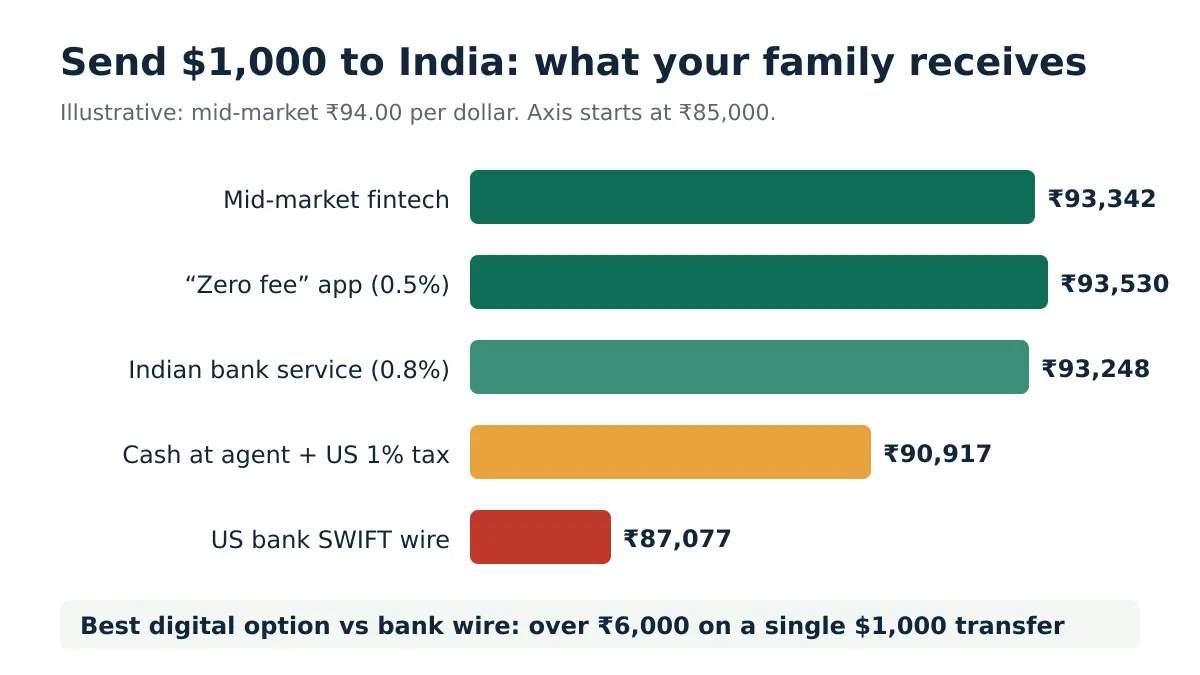
Profile: Sending $1,000 from the US. Assumed mid-market rate: ₹94.00 per dollar.
| Route | Assumptions | Family receives | Cost vs mid-market |
|---|---|---|---|
| Mid-market fintech | $7 fee, no markup | ₹93,342 | ₹658 (0.70%) |
| “Zero fee” app | $0 fee, 0.5% markup | ₹93,530 | ₹470 (0.50%) |
| Indian bank remittance service | $0 fee, 0.8% markup | ₹93,248 | ₹752 (0.80%) |
| Cash at an agent counter | $8 fee, 2.5% markup, +$10 US cash tax paid on top | ₹90,917 (you paid $1,010) | about ₹4,000 (4.2%) |
| US bank SWIFT wire | $45 fee, 3% markup | ₹87,077 | ₹6,923 (7.4%) |
These are made-up but realistic numbers to show how fees and markups stack up. Real quotes differ by provider and day. The wire row ignores any Indian-bank conversion and GST, which would increase its cost further.
The takeaway: the difference between the best digital option and a bank wire on just $1,000 is over ₹6,000. If you send $1,000 every month, that is more than ₹75,000 a year.
Part 8: Rules and taxes to know
In India
- Gifts from relatives are tax-free, with no upper limit. Money an NRI sends to parents, a spouse, children, siblings and other “relatives” as defined in the Income-tax Act is exempt in the recipient’s hands. A gift from a non-relative becomes taxable if the total crosses ₹50,000 in a year. From tax year 2026-27, this rule sits in Section 92(2)(m) of the Income-tax Act, 2025; it was Section 56(2)(x) of the 1961 Act.
- Keep records. Even exempt gifts can draw questions if large unexplained credits appear. Keep transfer receipts and, for large gifts, a simple gift letter.
- Cash-payout limits (MTSS). Money transfer services that pay out in cash (such as Western Union counters) run under RBI’s Money Transfer Service Scheme. Each remittance is capped at USD 2,500, a single beneficiary can receive only 30 remittances a calendar year, and cash payment is allowed only up to ₹50,000. These remittances cannot be credited to an NRE account and are for personal or family purposes only.
In the United States
- The 1% cash-funded remittance tax (Part 3).
- Gift tax reporting. For 2026, you can give up to $19,000 per recipient per year without filing. Above that, you file Form 709, but no tax is due until you use up your $15 million lifetime exemption. Most people sending money to family never owe US gift tax.
In the United Kingdom
- There is no tax on sending money abroad. For inheritance-tax purposes, you have a £3,000 annual gift exemption, and regular gifts made out of surplus income (such as monthly support for parents) can be exempt if they do not reduce your standard of living. Keep a record of regular transfers.
In the UAE
- There is no personal income tax and no tax on remittances. Only the 5% VAT on fees applies.
Part 9: A checklist before every transfer
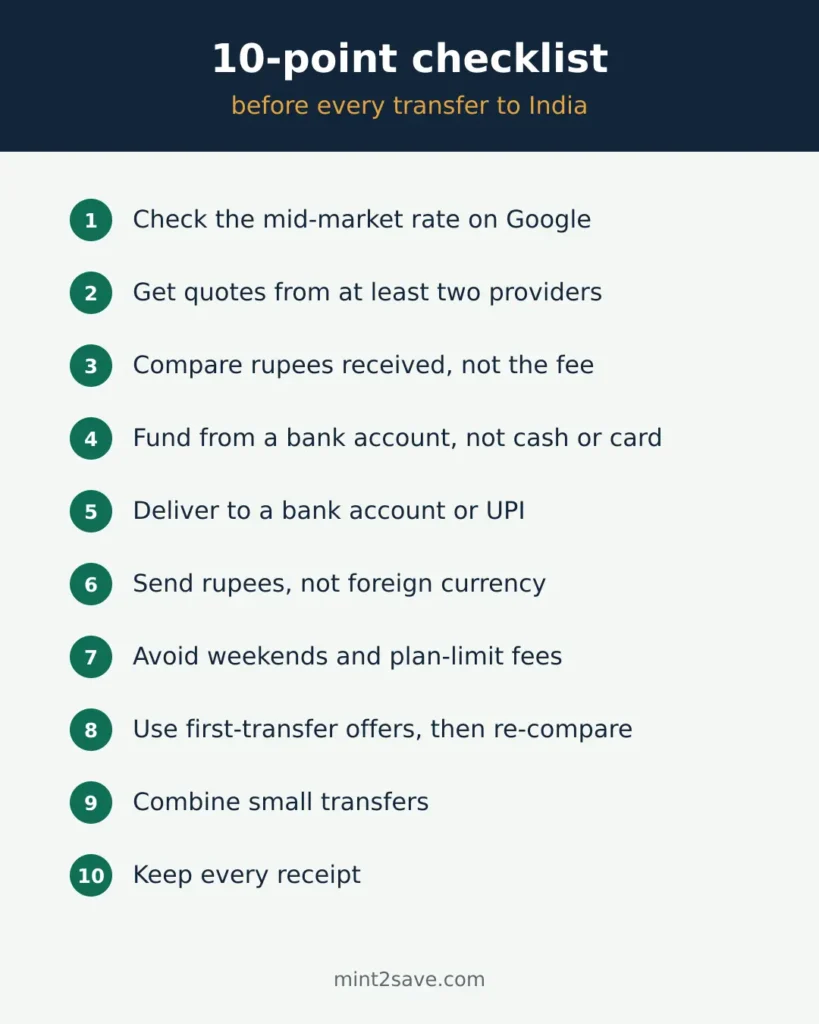
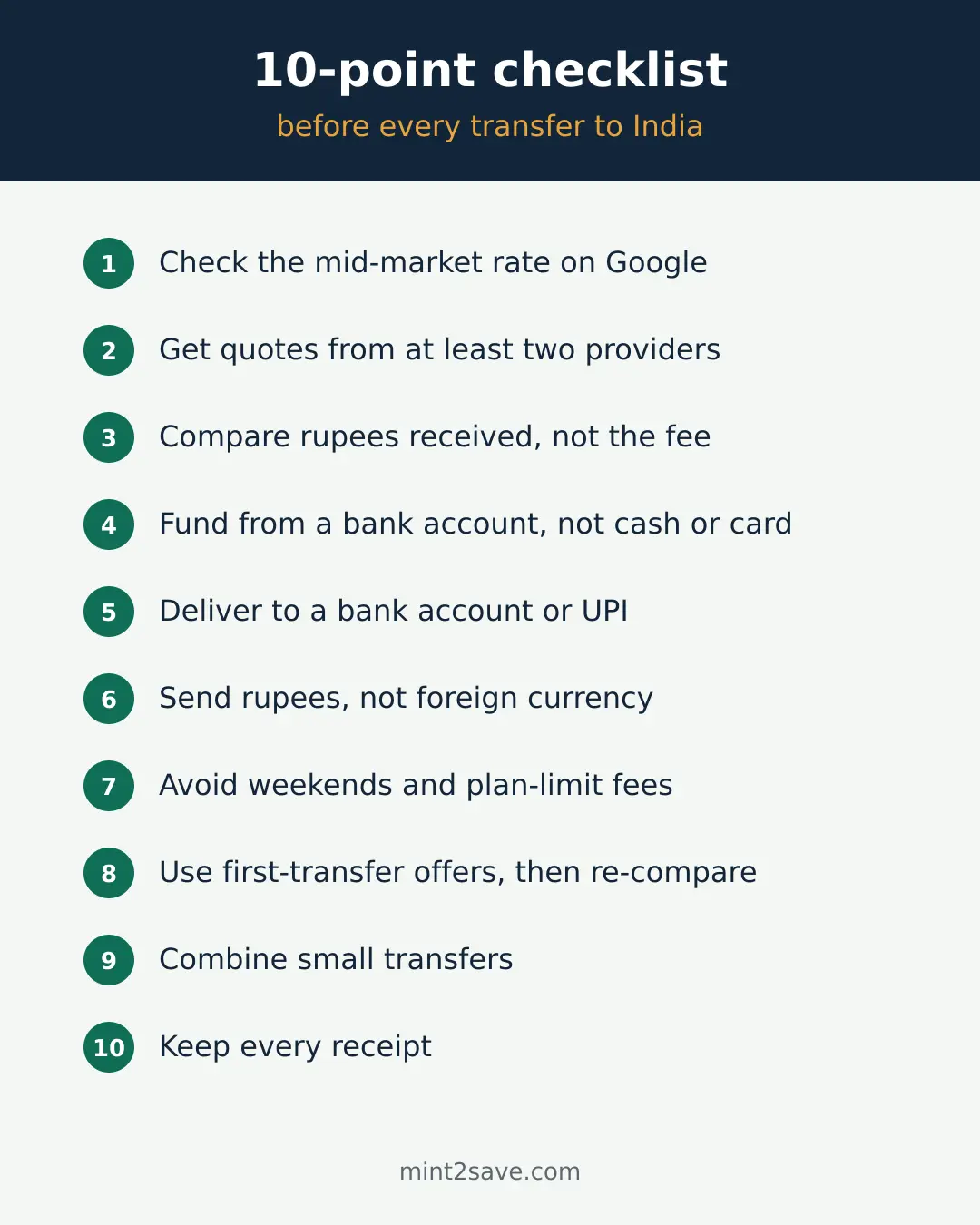
- Note the mid-market rate on Google or Reuters.
- Get quotes from at least two providers, ideally one mid-market fintech and one zero-fee app. For the UAE, add an exchange-house app.
- Compare the rupees received, not the fee or the headline rate.
- Fund from your bank account, not cash or a credit card.
- Deliver to a bank account or UPI, not cash pickup, unless the recipient has no account.
- Send rupees, not foreign currency, to avoid a second conversion and GST at the Indian bank.
- Watch the timing. Some services charge more at weekends or above monthly limits (Revolut, for example).
- Use first-transfer offers but compare again for the second transfer. Promotional rates do not last.
- Consolidate small transfers where you can. Fixed fees hurt most on small amounts.
- Keep receipts for tax and records.
Quick FAQ
Which is the single cheapest way to send money to India? There isn’t one. On any given day, the cheapest option depends on the corridor and amount. In 2026, the cheapest options are usually a mid-market fintech (Wise, Aspora) or a zero-fee app with a thin margin (Remitly, Taptap Send, LuLu Money in the UAE). Bank wires are rarely the cheapest for normal amounts.
Is “zero fee” really free? Rarely. The cost usually sits in the exchange rate. Compute the markup against the mid-market rate, or simply compare the rupees received.
Is it safe to use apps instead of banks? Use providers licensed in your country, such as FinCEN-registered and state-licensed in the US, FCA-authorised in the UK, or licensed by the Central Bank of the UAE. Check the regulator’s register if you are unsure.
Do my parents have to pay tax on the money I send? No, if they are “relatives” under the Income-tax Act and the money is a genuine gift. There is no upper limit.
Should I send to UPI or a bank account? Both are fine. UPI is usually instant, and many apps now offer it. For large amounts, a bank account credit is easier to document.
This article is for general information and education. It is not financial, tax or legal advice. Fees, exchange rates and promotions change daily, and tax rules depend on your circumstances. Check the live quote and the provider’s terms before you send, and speak to a qualified advisor for large or unusual transfers.
Figures in this article were collected in November 2026. Fees, promotional rates and exchange rates change daily. Treat the numbers as a guide and check the live quote before you send.
Related Posts

Subscribe to get the best of finance and fintech. Regularly.
Categories
Popular

- 31 May 2016 | 18624 Views

- 16 June 2020 | 16026 Views

- 19 May 2021 | 15533 Views

- 14 May 2021 | 12296 Views
Recent


- 12 November 2026

- 11 November 2026
- 10 November 2026