
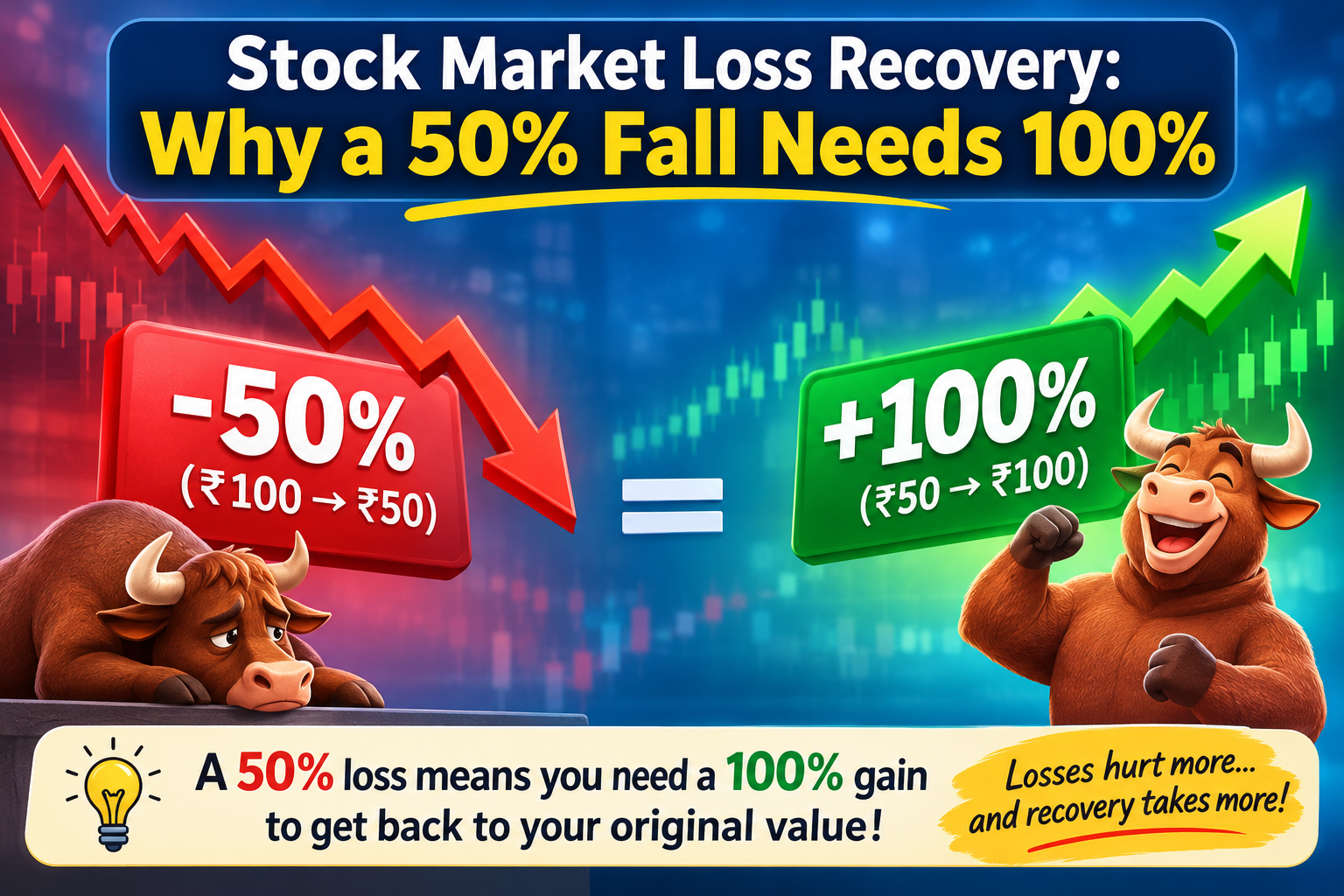
Stock Market Loss Recovery: Why a 50% Fall Needs 100%
- 11 November 2026 | 43 Views | By Mint2Save
Rohan had been waiting for this moment for months. When his annual bonus landed in March, he put ₹1 lakh into a mid-cap stock his colleagues couldn’t stop talking about. The company had a great story, the chart looked unstoppable, and he promised himself he would hold it for the long run.
Then the market turned. Within six months, the stock had halved. Every time he opened his trading app, the red number stared back at him: ₹50,000. He thought about selling, but decided to wait it out. “It’ll come back,” he told his wife. “It just has to go up 50% and I’m even.”
A year later, it did go up 50%. Rohan opened the app, ready to celebrate getting his ₹1 lakh back. The screen read ₹75,000.
He refreshed it, convinced something was wrong. Nothing was. The stock had fallen 50% and then risen 50%, and he was still ₹25,000 short. To get his money back, it now needed to climb another 33%. Measured from the bottom, it had needed to double.
Rohan is not alone. Ask most people whether a 50% fall followed by a 50% rise brings them back to where they started, and they will say yes without a second thought.
Rohan’s surprise hides one of the most important ideas in all of investing. Losses and gains are not mirror images of each other. A loss always needs a bigger gain to undo it, and the gap widens brutally as the loss gets deeper. Once you truly understand this, the way you think about risk changes for good.
Here is a question that trips up a surprising number of investors. You put ₹1 lakh into a stock. It falls 50%. A few months later, it rises 50%. Are you back to ₹1 lakh?
Most people say yes almost instantly. Down fifty, up fifty, back to where you started. It feels like simple arithmetic.
The real answer is no. You are sitting at ₹75,000, still down a quarter of your money.
This small puzzle hides one of the most important ideas in all of investing. Losses and gains are not mirror images of each other. A loss always needs a bigger gain to undo it, and the gap widens brutally as the loss gets deeper. Once you truly understand this, the way you think about risk changes for good.
In this article, we will walk through the math, see why deep losses are so hard to climb out of, and look at the practical habits that disciplined traders and investors use to stay out of the hole in the first place.
Why the math works against you
The trick is that every percentage is calculated on a different base. Let’s trace the ₹1 lakh step by step.
- The fall. A 50% drop on ₹1,00,000 wipes out ₹50,000. You are left with ₹50,000.
- The rise. A 50% gain is now calculated on ₹50,000, not on ₹1 lakh. That adds only ₹25,000. You are at ₹75,000.
- The gap. To get from ₹50,000 back to ₹1,00,000, the stock has to rise by ₹50,000 on a base of ₹50,000. That is a 100% gain. Your money has to double just to break even.
The loss hit a big number; the recovery works off a small one. That asymmetry is permanent, and it applies to every asset: shares, mutual funds, gold, crypto, even a business’s revenue.
There is a simple formula for the gain you need after any loss. If L is your loss as a decimal, the recovery required is:
Required gain = Loss/(1 - L)Plug in a 50% loss and you get 0.5 ÷ 0.5 = 1, or 100%. Plug in 20% and you get 0.2 ÷ 0.8 = 0.25, or 25%. The denominator is what you have left. As your remaining capital shrinks, the required gain explodes.
The order does not rescue you either. Rise 50% first and then fall 50%, and ₹1 lakh becomes ₹1.5 lakh and then ₹75,000. Same destination. Volatility on its own quietly eats into your money, even when the ups and downs look “balanced”.
The deeper the hole, the steeper the climb
Small losses are easy to repair. A 10% fall needs just an 11% gain. A 20% fall needs 25%. Up to this point, your intuition is roughly right.
Past that, the curve turns sharply upward. A 50% fall needs 100%. An 80% fall needs 400%, meaning the stock has to become five times its bottom price just to get you back to zero. A 90% fall needs 900%.
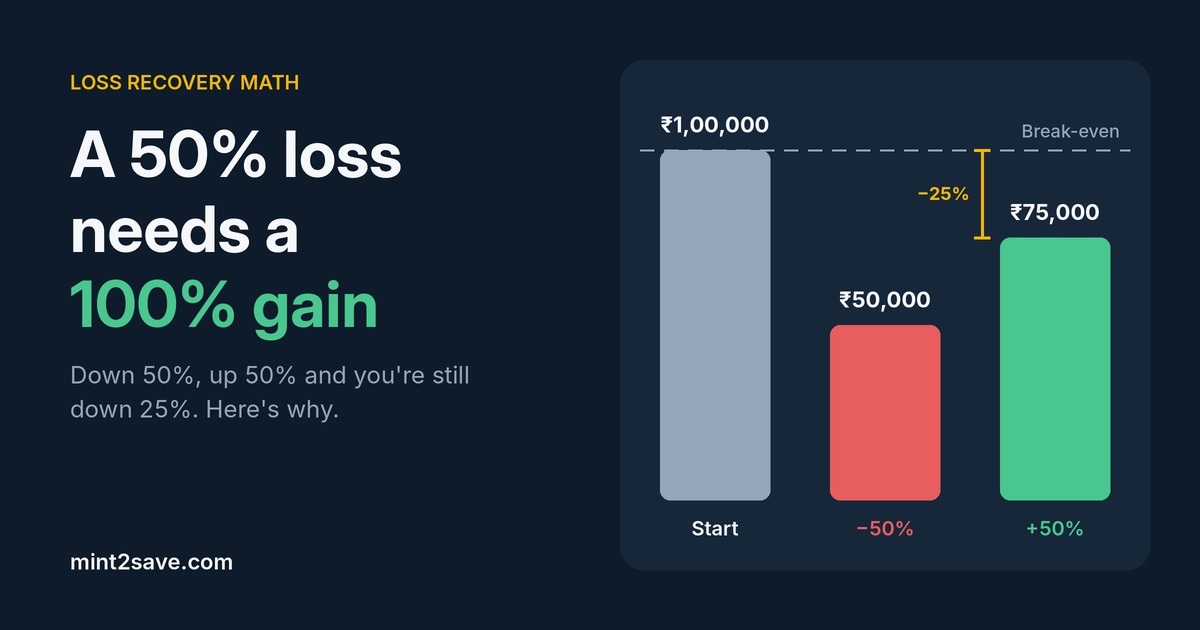
The gap between the dashed tick and the top of each bar is the trap. It is small on the left and enormous on the right.
There is also a hidden cost: time. Suppose your money grows at a healthy 12% a year after a loss. Recovering from a 20% fall takes about 2 years. A 50% fall takes about 6 years. An 80% fall takes about 14 years. Those are years in which your capital is merely catching up, not compounding toward your goals.
This is why a single catastrophic loss can undo a decade of careful gains, and why so many stocks that crashed 80–90% never returned to their old highs at all.
Think about the loss before the profit
Good traders think about the loss before they think about the profit. That is not pessimism. It is arithmetic. If big losses are this expensive to repair, the highest-return move is often simply not taking them. Three habits follow.
1. Keep risk small on every trade
Many professional traders cap the amount they can lose on a single trade at around 1–2% of their total capital. With ₹1 lakh, that means a maximum loss of ₹1,000–₹2,000 per trade.
The beauty of this rule is that a losing streak stays survivable. Ten losses in a row at 2% each leaves you down about 18%, which needs roughly a 22% gain to repair. Ten losses at 10% each leaves you down about 65%, which needs nearly 190%. Same number of mistakes, completely different outcome.
2. Decide your stop loss before you enter
A stop loss is the price at which you accept you were wrong and exit. The key word is before. Once you are in a losing trade, your judgement is clouded by hope, regret and the urge to “wait until it comes back”. Deciding the exit in advance, when you are calm, takes emotion out of the decision.
It also lets you size the position properly. If your stop is 5% below your entry and you are willing to lose ₹2,000, your position size should be about ₹40,000, not your whole ₹1 lakh.
3. Don’t keep adding money to a losing trade
This is the most tempting mistake of all. The stock has fallen, it looks “cheap”, so you buy more to bring down your average price. Sometimes it works. But when it doesn’t, you have put more capital into exactly the position that is proving you wrong. A 30% fall on a position you doubled becomes a much bigger rupee hole, and the recovery math above applies to all of it.
But isn’t averaging, or DCA, a sound strategy? Sometimes it is, and the distinction is worth drawing. A planned SIP into a diversified index fund, made on a fixed schedule regardless of price, is a long-term investing discipline. Throwing extra money at a single falling stock because you can’t accept the loss is an emotional reaction. The first is a strategy decided in advance; the second is usually a stop loss you didn’t respect.
What about long-term investors?
What about investing, as opposed to trading? The recovery math applies just the same. The difference is in how you manage it.
A long-term investor rarely uses tight stop losses, because broad markets do recover over time and selling at every dip can lock in losses. Instead, investors control the size of the potential hole in other ways:
- Diversify. A single stock can fall 80% and never come back. A diversified index fund holding 50 or 100 companies is far less likely to suffer that kind of permanent damage.
- Match equity exposure to your timeline. Money you need in two years should not sit in an asset that can fall 40%. A loss you are forced to sell at is the one that never recovers.
- Rebalance. Trimming what has run up and adding to what has lagged keeps any one holding from dominating your portfolio.
- Avoid leverage. Borrowed money magnifies losses and can force you out at the worst moment, before any recovery arrives.
The goal is the same for traders and investors: avoid the deep, unrecoverable loss. Steady, moderate returns with small drawdowns usually beat flashy returns with occasional crashes, because compounding works best when it is not constantly interrupted.
The bottom line
A 50% fall followed by a 50% rise leaves ₹1 lakh at ₹75,000. That one fact explains why experienced market participants obsess over protecting capital. Every rupee you don’t lose is a rupee that doesn’t need a heroic recovery.
So before your next trade or investment, ask the loss question first. How much can I lose here? Where will I get out? Am I adding money because of a plan, or because I can’t accept being wrong?
Which of these mistakes have you made: oversized positions, no stop loss, or averaging down on a loser? Be honest with yourself. Fixing just one of them can change your results more than finding the next big winner.
Calculations use simple percentage math and ignore brokerage, taxes and other charges. This article is for education only and is not investment advice. Please consult a SEBI-registered adviser before making investment decisions.
Related Posts


Subscribe to get the best of finance and fintech. Regularly.
Categories
Popular

- 31 May 2016 | 18604 Views

- 16 June 2020 | 16011 Views

- 19 May 2021 | 15515 Views

- 14 May 2021 | 12280 Views
Recent
- 11 November 2026

- 10 November 2026
